
A full, well-balanced buttock is one of the body-shape goals many people care about. When training routines or soft-tissue enhancement methods fail to deliver the desired volume, buttock augmentation with an implant may be an option a doctor considers in suitable cases.
In practice, however, not everyone is suited to the same type of buttock implant. Gluteal muscle volume, the overlying soft tissue layer, buttock width, body proportions, skin condition, and aesthetic goals all influence the choice of implant.
So what types of buttock implants exist today? Where do Sebbin, Polytech, Nagor, and Eurosilicone implants come from? And what does the term “Ergonomix buttock implant” actually mean? Here is what you need to know before making a decision.
What is a buttock implant?
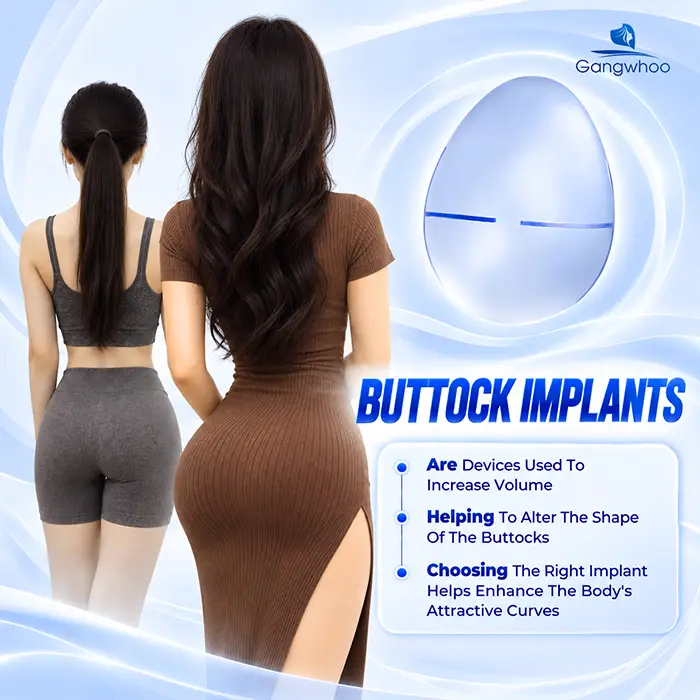
A buttock implant, or gluteal implant, is a medical device used in reconstructive/plastic surgery to increase volume and reshape the buttock area.
Unlike autologous fat grafting, this method uses an implant designed with specific parameters for shape, size, volume, and projection. The surgeon evaluates the patient’s anatomy before selecting the appropriate implant type and placement technique.
According to Sebbin’s instructions for use, gluteal implants containing silicone gel are used in cosmetic and reconstructive surgery; indications may include gluteal hypoplasia, ptosis (sagging) of the buttock area, or lateral buttock depressions. This documentation also emphasizes that patient selection, implant type, shape, volume, profile, and placement position are the surgeon’s responsibility.
Therefore, when researching which type of buttock implant is best, I believe the more appropriate question is: which implant type suits the patient’s body structure and aesthetic goals?
What types of buttock implants are there?
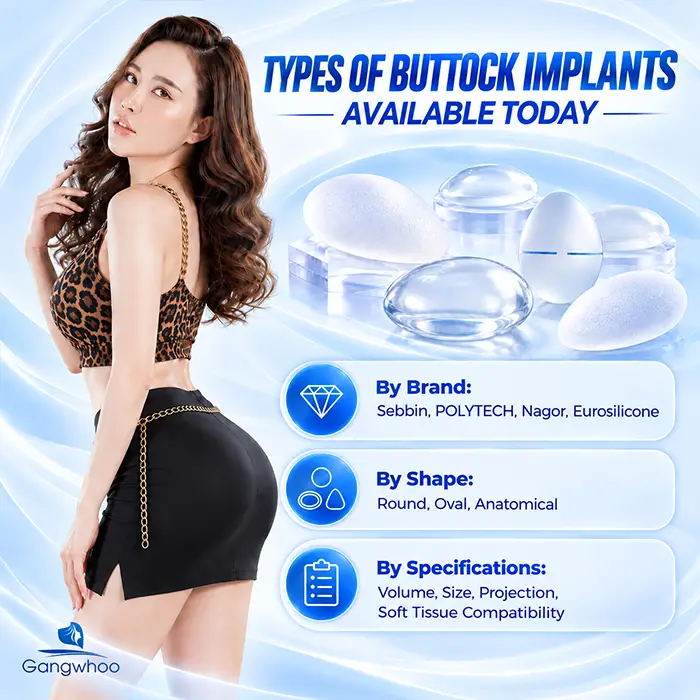
Buttock implants can be classified according to different criteria. By brand, the international market includes names such as Sebbin, POLYTECH, Nagor, Eurosilicone, and several other manufacturers.
By shape, gluteal implants may be designed as round, oval, or other anatomical configurations depending on the manufacturer.
By technical specifications, surgeons typically focus on volume, implant base width, height, projection, and compatibility with the patient’s soft tissue.
This is why I do not recommend that patients decide based on brand name alone. Two people of the same height can have completely different pelvic structure, gluteal muscle, and soft tissue layers, which leads to different implant choices.
Top buttock implant types of interest today
1. Sebbin buttock implants – a French brand
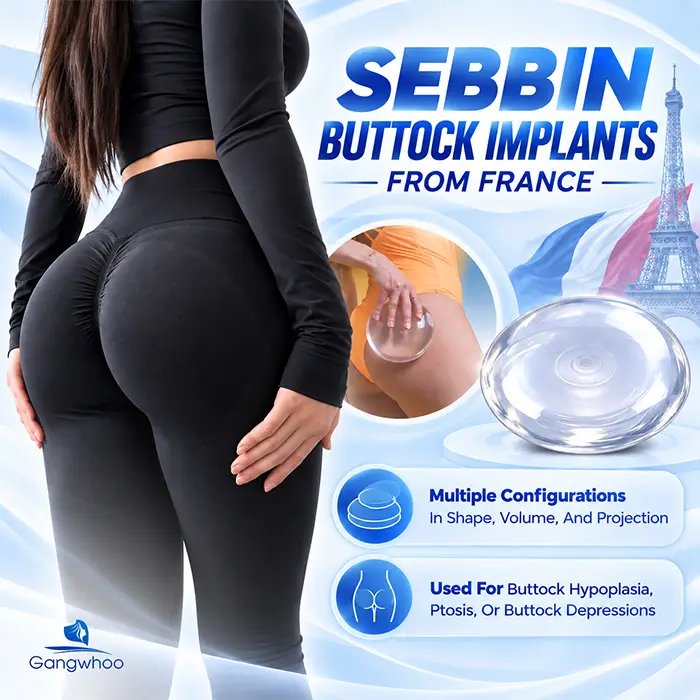
Sebbin is one of the brands with dedicated product documentation for gluteal implants. Sebbin’s official instructions for use identify this as a silicone gel-filled gluteal implant used in cosmetic and reconstructive surgery.
In terms of origin, Sebbin is a French brand. The company’s official documentation uses the name Sebbin Paris and provides separate instructions for use for its gluteal implant product.
a. What shapes does the Sebbin buttock implant come in?
A notable feature of Sebbin is that its gluteal implant product comes in multiple configurations for the surgeon to consider based on anatomy.
According to the product documentation, selection should not be based on brand alone but must also consider shape, volume, profile, and implant placement position. These are parameters that directly affect the aesthetic outcome.
From a reconstructive surgery standpoint, this matters a great deal. For example, someone whose buttock lacks overall volume has different needs from someone who mainly lacks projection in one particular area. The surgeon needs to evaluate both aspects to reduce the risk of postoperative asymmetry.
b. Who is Sebbin suitable for?
According to the manufacturer’s instructions for use, Sebbin gluteal implants may be used in cases of gluteal hypoplasia, ptosis, or depression of the buttock area; there are also reconstructive indications for certain medical conditions or after-effects.
However, “having an indication” does not mean “suitable for everyone.” The surgeon still needs to assess health status, soft tissue, gluteal muscle, buttock structure, and aesthetic expectations before deciding.
2. POLYTECH buttock implants – made in Germany
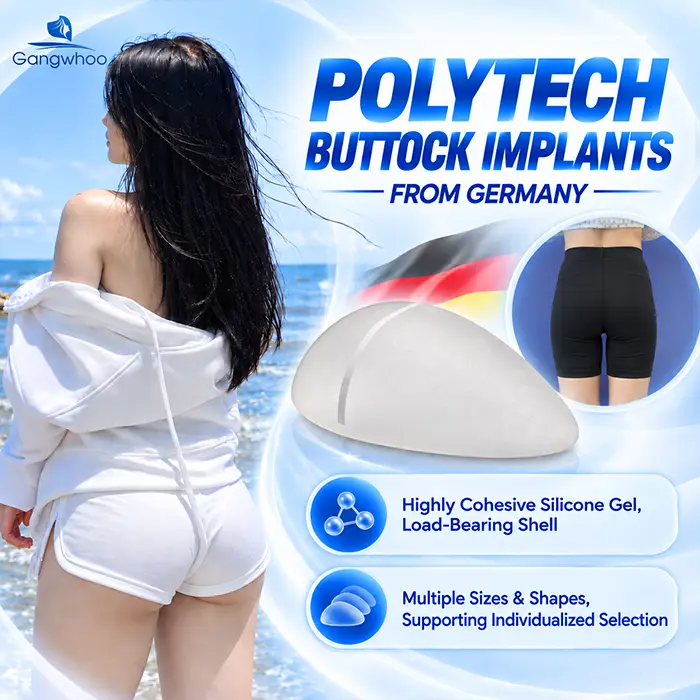
POLYTECH Health & Aesthetics is a German implant manufacturer. According to the company’s official information, POLYTECH is headquartered in Dieburg, Germany, and its products are manufactured in Germany.
For the buttock area, POLYTECH has its own gluteal implants line. The company states these implants come in multiple sizes with round or elliptical/oval shapes for the surgeon to choose based on each patient’s body.
One notable structural feature is that POLYTECH describes its gluteal implants as using highly cross-linked silicone gel with a shell designed to withstand mechanical stress. The company designs the product to meet the specific demands of the buttock area, which bears significant mechanical pressure during daily activities, including sitting.
What are the advantages of POLYTECH buttock implants?
What matters here is not calling this “the best implant,” but the fact that the manufacturer offers a dedicated gluteal implant line with multiple sizes and shapes for the surgeon to consider.
From a reconstructive surgery perspective, having more parameters to choose from gives the surgeon more options for personalization. However, more options does not mean the patient should choose the largest possible volume.
3. Nagor buttock implants – a brand of British origin
Nagor is an implant brand originating from the United Kingdom. According to the company history published by GC Aesthetics, the company was founded in the UK in 1979; it later expanded operations into France and acquired the Eurosilicone and Nagor brands in 2008.
However, there is one important point readers should understand clearly: the Nagor/GC Aesthetics product ecosystem is currently published mainly with a focus on breast implants and related breast surgery solutions. GC Aesthetics states that Nagor and Eurosilicone have been transitioning to the GCA brand since 2020.
Therefore, when a facility advertises a “Nagor buttock implant,” patients should ask for the specific model name, product profile, and indication for use in the buttock area rather than relying on the brand name alone.
This is a principle I always prioritize: for a medical device placed inside the body, the exact product must be identified, not just the brand.
4. Eurosilicone buttock implants – a brand of French origin
Eurosilicone is a brand originating from France. According to GC Aesthetics’ historical information, the company was founded in France in 1988 and later acquired Eurosilicone along with Nagor in 2008.
Eurosilicone is now part of the GC Aesthetics ecosystem. The manufacturer publishes long-term clinical data for Eurosilicone’s breast implant products, but this should not be taken to mean that every product under the brand is a buttock implant or shares the same indication for the buttock area.
Therefore, if a patient is being advised on a Eurosilicone buttock implant, it is necessary to verify precisely whether the model being used is in fact a gluteal implant and whether that product is approved for the corresponding indication where the surgery is performed.
Comparing buttock implant types
| Implant type/brand | Brand origin | Confirmed gluteal implant documentation | Notable point |
|---|---|---|---|
| Sebbin | France | Yes | Has official gluteal implant documentation |
| POLYTECH | Germany | Yes | Gluteal implant available in multiple sizes and shapes |
| Nagor | UK | Model must be verified | Brand under the GC Aesthetics ecosystem |
| Eurosilicone | France | Model must be verified | Brand under GC Aesthetics |
| Motiva Ergonomix | Costa Rica | Should not be assumed to be a buttock implant | Official documentation reviewed refers to breast implants |
| “Ergonomic” at Gangwhoo | Model must be cross-checked | Must be verified against product records | Should not be automatically equated with Motiva Ergonomix |
The table above shows an important point: “brand origin” and “manufacturing origin of each specific model” are not always the same concept. When advising on an implant, the surgeon must rely on the specific device’s documentation.
Which type of buttock implant is best?
If asked which type of buttock implant is best, the professional answer is: there is no single best implant for every patient.
In reconstructive surgery, my primary concern is the compatibility between the implant and the patient’s body.
An implant that suits one person may not suit another due to differences in buttock width, muscle mass, subcutaneous fat layer, skin elasticity, and aesthetic goals.
So instead of asking “which implant is best?”, patients should ask:
Which implant shape suits me?
What volume is appropriate?
What degree of projection suits my body?
Is this specific model indicated for use in the buttock area?
These are the questions that give the implant selection process a stronger medical basis.
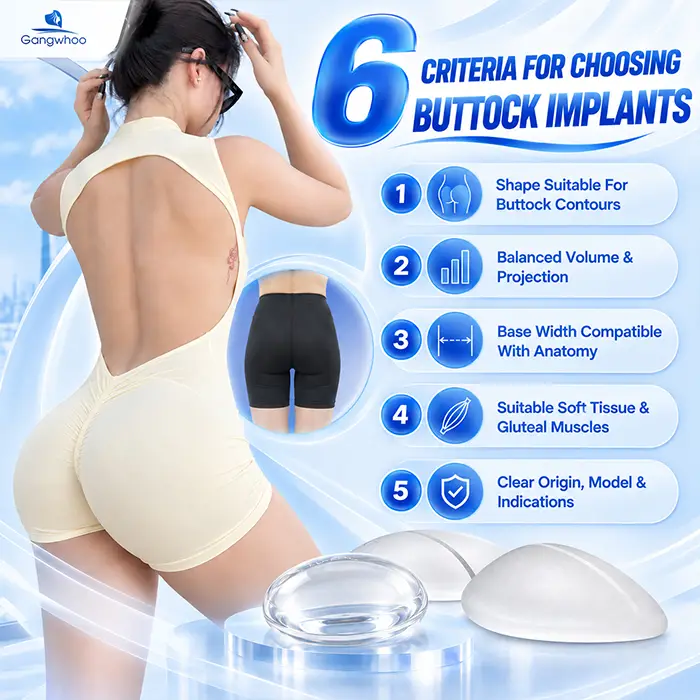
6 criteria for choosing a buttock implant
1. Implant shape
The implant shape needs to be compatible with the buttock’s form and the aesthetic goal. Some gluteal implants are manufactured in round, oval, or other anatomical configurations.
POLYTECH, for instance, offers gluteal implants in round or elliptical shapes.
Sebbin also requires the surgeon to consider shape together with volume, profile, and implant placement position.
2. Volume
Volume should not be chosen based on the idea that “bigger is more beautiful.”
An implant that is too large relative to the pocket and soft tissue layer can increase pressure on the tissue, affect the resulting shape, and may increase the risk of complications.
Conversely, an implant that is too small may fail to achieve the aesthetic goal.
3. Projection
Projection significantly determines the side-profile shape of the buttock.
Someone who wants more projection will have different selection criteria than someone who mainly needs more volume on both sides.
4. Implant base width
The base width needs to match the buttock’s anatomy. This is one of the important parameters that patients often overlook when focusing only on the cc volume number.
5. Soft tissue layer and gluteal muscle
The surgeon needs to assess soft tissue thickness and muscle mass before selecting an implant.
This is also why one should not apply another person’s measurements to oneself.
6. Origin and device documentation
An implant used inside the body needs clear information about the manufacturer, model, indications, instructions for use, and supply source.
To me, this is a factor that cannot be overlooked.
Gangwhoo Aesthetic Hospital – A buttock augmentation destination many customers are interested in
When researching buttock augmentation with implants, besides the surgeon and implant type, patients should also consider surgical conditions, supporting equipment systems, and postoperative care procedures. Gangwhoo Aesthetic Hospital is one of the facilities many customers consider when researching methods to improve buttock shape, including endoscopic buttock augmentation with implants and autologous fat grafting.
1. A team of surgeons specializing in abdominal, breast, and buttock reconstruction
Buttock augmentation with an implant is a reconstructive surgical technique that requires the surgeon to accurately assess anatomical features, soft tissue volume, buttock shape, and body proportions before making a recommendation. At Gangwhoo Aesthetic Hospital, the specialist team includes doctors focused on abdominal, breast, and buttock reconstruction, including Dr. (CKI) Vi Van Cuong.
Rather than choosing an implant size based on a desired degree of largeness, patients need to be examined to determine the appropriate implant volume, shape, placement position, and surgical method suited to their body structure. This is an important step that helps balance aesthetic goals with surgical safety requirements.
2. Surgical support with a 4K endoscopic system and Harmonic scalpel
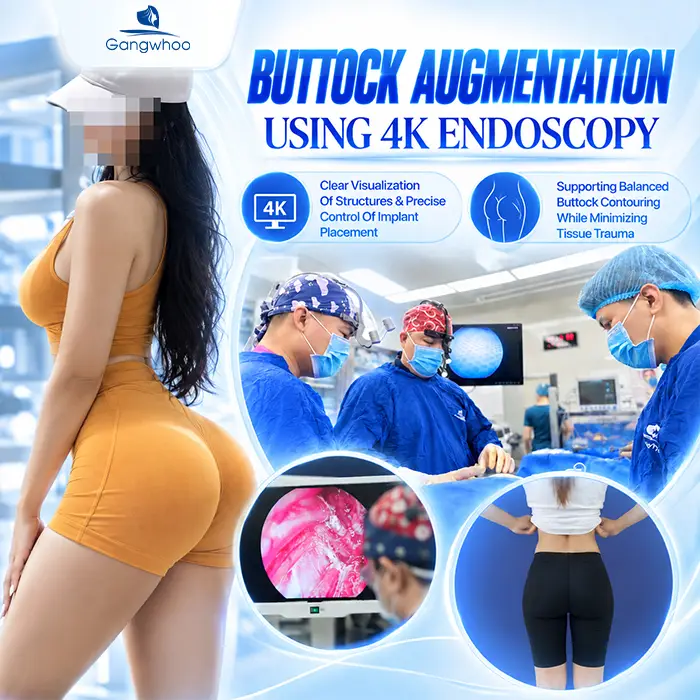
One point Gangwhoo emphasizes in its surgical process is the use of modern supporting equipment, including a 4K endoscopic system and Harmonic scalpel.
For endoscopic buttock augmentation, the 4K endoscopic system helps the surgeon observe the surgical field on screen in high resolution, making it easier to identify the surgical area and carry out dissection and pocket-creation steps according to plan. The use of endoscopy is also intended to help control surgical maneuvers through an appropriate access approach.
In addition, the Harmonic scalpel uses ultrasonic energy to assist with cutting and hemostasis during surgery. This device can help the surgeon control tissue and the surgical field during the procedure. However, technology only plays a supporting role; the outcome and safety of the surgery still depend on the indication, the surgeon’s expertise, each patient’s actual condition, and the postoperative care process.
Combining the endoscopic buttock augmentation technique with the 4K endoscopic system and Harmonic scalpel can therefore be considered one of the supporting factors in the surgical process at Gangwhoo, rather than the sole factor determining the aesthetic outcome.
3. Consultation on augmentation methods based on actual condition
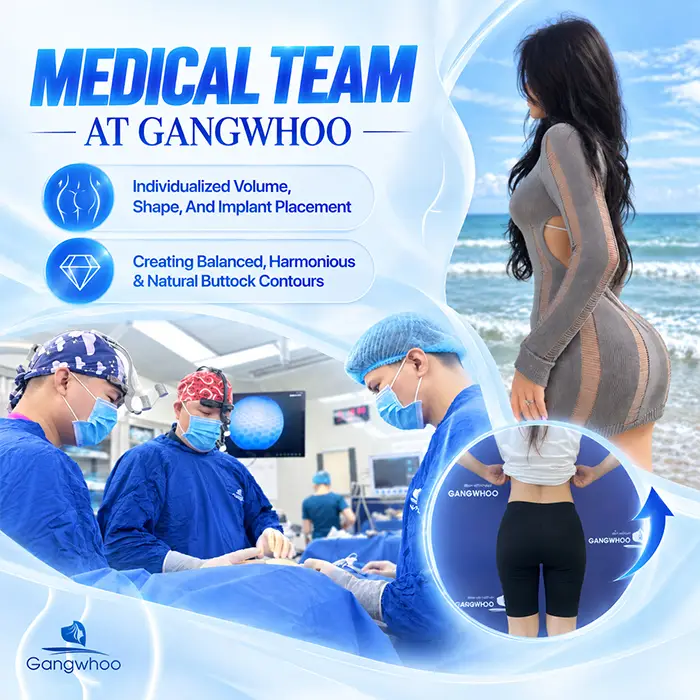
Not every case is suited to the same buttock augmentation method. Someone whose buttock lacks volume but whose soft tissue responds well may be considered for implant-based augmentation; meanwhile, some cases with sufficient autologous fat may be evaluated for fat grafting. Some patients may also need a combination of techniques to simultaneously improve volume, curve, and buttock proportions.
At Gangwhoo, customers are advised based on their actual condition rather than choosing a method based solely on its name or implant size. For patients interested in implant-based buttock augmentation, the surgeon needs to assess factors such as buttock shape, soft tissue thickness, muscle structure, skin condition, and body proportions before determining the appropriate plan.
In particular, when advised on a specific type of buttock implant, customers should request full information on the brand, manufacturer, origin, model, volume, shape, indications for use, and product documentation. This helps patients understand exactly which implant they are receiving rather than relying only on the trade name.
4. Emphasis on pre- and post-operative monitoring
A buttock augmentation case does not end when the surgery is complete. The postoperative period plays an important role in recovery, monitoring the surgical wound, tracking any abnormal signs, and assessing the stability of the buttock area after implant placement.
Therefore, in addition to surgical technique and supporting equipment, patients should choose a facility with a clear pre-operative examination process, postoperative monitoring, and care instructions. If any abnormal symptoms appear after surgery, patients should contact the treating facility immediately or go to a medical facility for direct evaluation.
5. Should you choose Gangwhoo for buttock augmentation with an implant?
Choosing Gangwhoo Aesthetic Hospital or any other facility for buttock augmentation should be based on multiple factors, not solely on advertising about technology or implant brands.
Patients should prioritize a facility with appropriately trained surgeons, a clear surgical process, operating room conditions that meet requirements, suitable supporting equipment, and the ability to monitor and manage any issues that may arise after surgery.
For customers interested in endoscopic buttock augmentation at Gangwhoo, learning in advance about the performing surgeon, the 4K endoscopic system, the Harmonic scalpel, the implant type used, the implant’s origin, and the postoperative care plan will help make the selection process more informed and proactive. If you are unsure which buttock implant type to choose, you should discuss it directly with a specialist rather than deciding based on images or figures found online. The final aesthetic outcome always depends on individual anatomy, the technique indicated, and the postoperative care process.