
Does brow lift surgery leave scars? This is one of the questions I’m most often asked when consulting with clients who have drooping eyebrows, sagging upper eyelid skin, or early signs of forehead aging.
The medically accurate answer is: a brow lift can leave a scar at the incision site, since it is a procedure/surgery that affects the tissue. However, whether the scar is clearly visible or not depends on the technique used, the location and design of the incision, each person’s healing ability, and the post-operative care process.
Therefore, brow lift surgery should not be understood as always “scar-free.” The realistic goal of cosmetic surgery is to optimize the incision location and the healing process so the resulting scar is as inconspicuous as possible. Professional literature on brow lifts also notes scarring as one of the possible risks after surgery, while less invasive techniques or incisions placed within the hairline can help reduce the visibility of the scar.
Does Brow Lift Surgery Leave Scars?
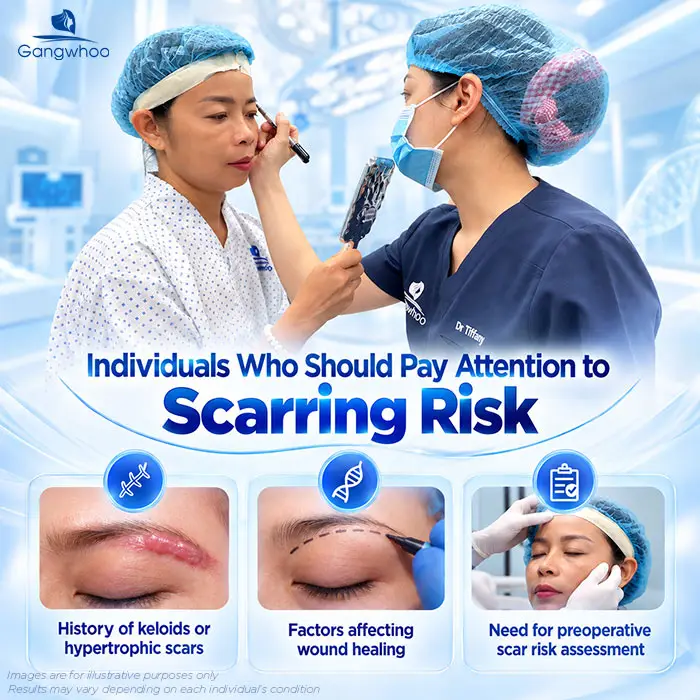
Fundamentally, any brow lift method that involves a skin incision has the potential to form a scar. After the tissue is sutured and heals, the body forms scar tissue as part of the wound-repair process.
What matters isn’t simply “will there be a scar or not,” but rather where the scar is located, how large it is, and how noticeable it becomes once fully matured.
In brow lift surgery, the doctor may choose different approaches depending on the patient’s anatomy, degree of brow ptosis, skin quality, hairline position, and aesthetic goals. With the endoscopic technique, the incisions are typically small and placed within the hair-bearing scalp, which can help reduce scar visibility compared to larger, more extensive incisions.
However, whether a scar is inconspicuous or not doesn’t depend solely on the name of the technique. The surgeon’s skill, tissue handling, wound-closure method, individual healing tendencies, and post-operative care all play a role.
Where Do Scars From Brow Lift Surgery Typically Form?
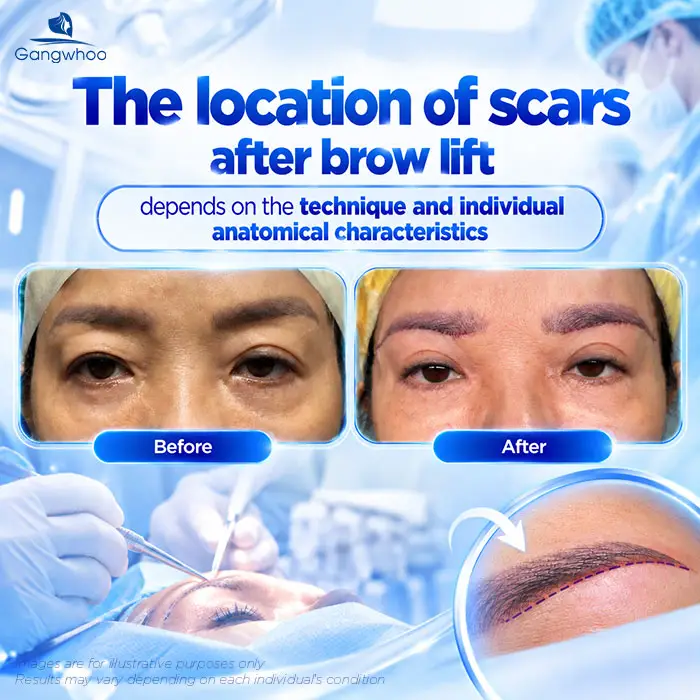
The location of the scar depends directly on the brow lift technique chosen.
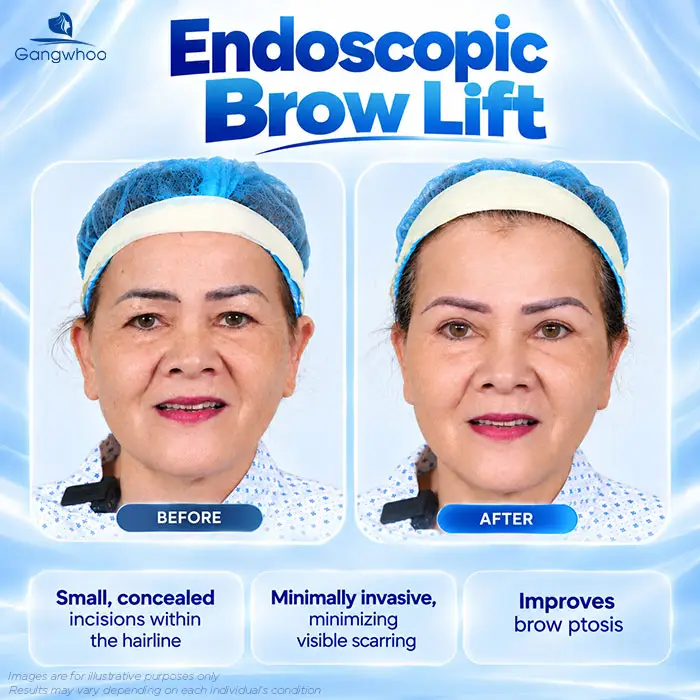
With an endoscopic brow lift, the surgeon typically makes several small incisions in the scalp behind the hairline to insert the endoscopic camera and surgical instruments into the forehead area. These small incisions are then closed. One advantage of the endoscopic approach is that the incisions can be hidden within the hair, reducing the chance of a visible scar.
With other techniques, the incision may be placed along the hairline, at the temples, or just above the eyebrow, depending on the indication. Today, the choice of incision location shouldn’t be based simply on a desire for “no scar,” but should weigh the degree of lift needed, anatomical features, and how well the scar can be concealed.
At Gangwhoo Cosmetic Hospital, brow lift and endoscopic brow lift are among the eye-area aesthetic services the hospital offers.
Does Endoscopic Brow Lift Leave Scars?
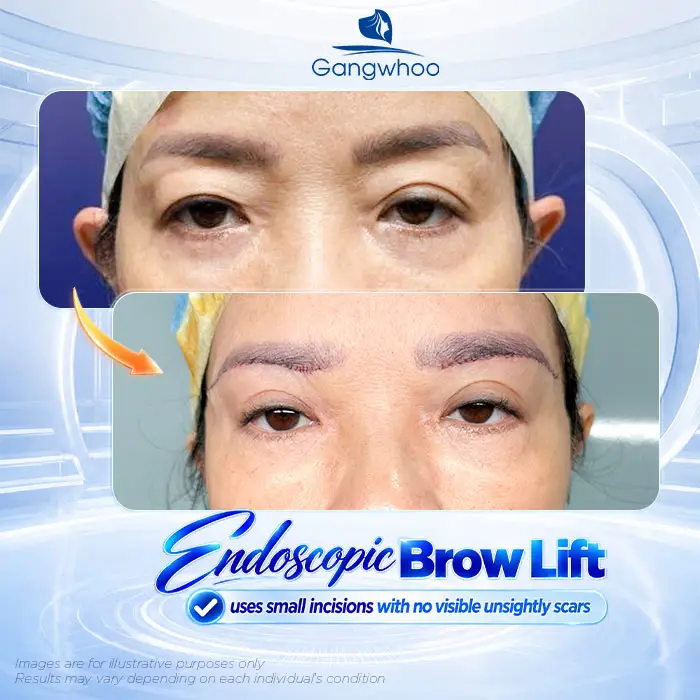
This is a question I get quite often when clients are researching the endoscopic brow lift method.
A scar can still form, but it’s usually smaller and placed in a more discreet location compared to some methods that use larger incisions. Gangwhoo Cosmetic Hospital describes the endoscopic technique as using small incisions within the hairline to introduce the endoscope and instruments into the surgical area.
Gangwhoo also notes that the endoscopic brow lift uses several short incisions on the scalp and has the advantage of being less invasive, with a smaller resulting scar compared to larger incisions. However, “less scarring” does not mean “no scarring.”
This is a point clients need to understand clearly before undergoing the procedure. In medicine, there is no basis for absolutely guaranteeing that any surgical method will produce no scar in every patient.
Factors That Determine Whether a Brow Lift Scar Is Noticeable
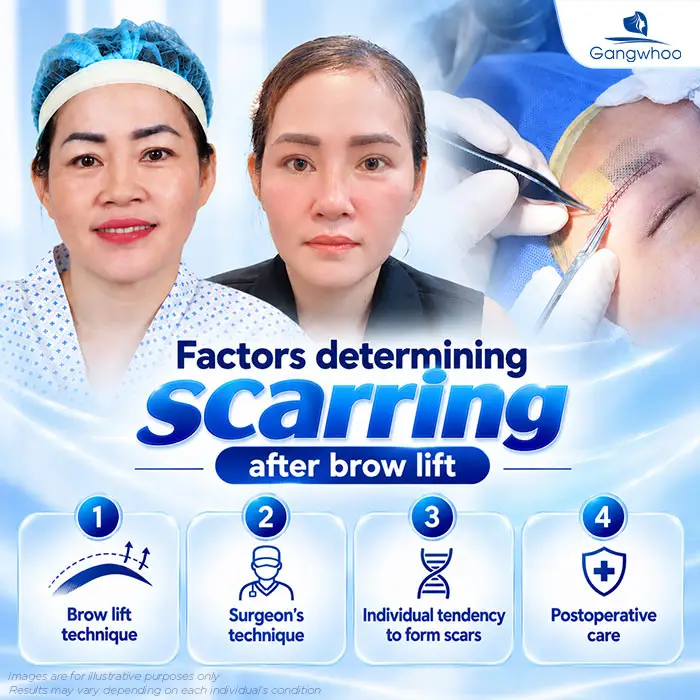
1. Brow Lift Technique
Each method involves a different approach to tissue and a different incision location. Endoscopic brow lift typically uses small incisions within the hair-bearing scalp, while other methods may use incisions in different locations.
Therefore, before undergoing surgery, clients should have the doctor clearly explain where the incision will be, its approximate length, and why that technique is suitable for their particular condition.
2. The Surgeon’s Technique
The incision location is only part of the story. In cosmetic surgery, tissue dissection, bleeding control, minimizing tissue trauma, and closing the wound in the correct layers all matter for the healing process.
An incision placed in a favorable location can still result in a more noticeable scar than desired if wound care is improper or if healing complications occur.
Therefore, choosing a surgeon with appropriate expertise and a facility with clear surgical and post-operative care protocols is a factor that deserves serious consideration.
3. Individual Scarring Tendency
Not every body forms scars the same way.
Some people have a tendency to form hypertrophic or keloid scars, while others may develop a thin, flat scar line once the wound has stabilized.
If you’ve previously had keloid or hypertrophic scars, or a history of abnormal healing, be sure to inform your doctor before the procedure. This is important information for the doctor to assess risk and recommend an appropriate plan.
4. Post-Operative Care
After surgery, the incision needs time to heal and mature. Applying strong pressure to the surgical area, scratching the incision, or not following care instructions can affect the healing process.
According to ASPS, the initial healing phase after a brow lift can last around 10–14 days, but the scar continues to settle and fade over the following weeks to months. Wound care and following the doctor’s instructions play an important role during this period.
How Long After a Brow Lift Does the Scar Fade?
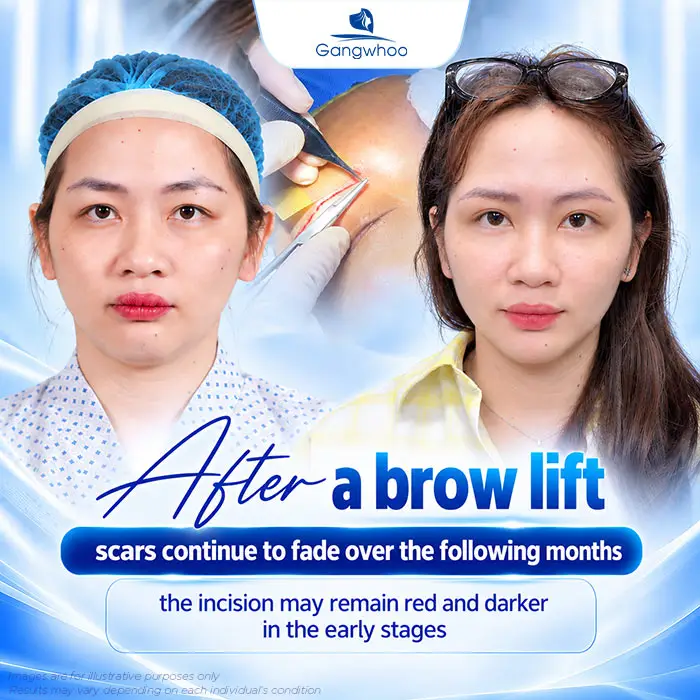
There is no single timeline that applies to every patient.
In the first few days, the surgical area may show swelling, bruising, tightness, or sensitivity. These are all possible manifestations during the post-surgical recovery process.
Once the wound has closed, the scar continues to undergo collagen remodeling. Therefore, the scar’s final appearance shouldn’t be judged too early.
ASPS notes that brow lift results continue to change as swelling subsides and the incision gradually fades; full recovery can take several months.
So if you’re only a few days or weeks post-op and the incision still looks somewhat red, dark, or not fully soft, that doesn’t mean it will be a permanent, unattractive scar.
What Types of Scars Can Occur After a Brow Lift?
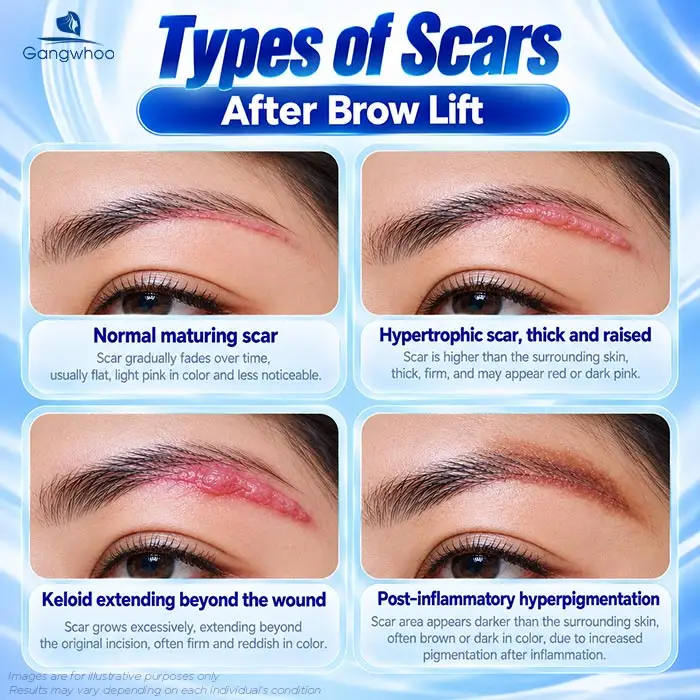
During consultations, I often explain to clients the difference between a maturing scar and a pathological scar.
A normal scar may change in color and softness during the healing process. Over time, the scar tends to become more stable.
In contrast, a hypertrophic scar is usually thick and raised but stays within the boundaries of the wound, while a keloid scar can grow beyond the original wound’s edges. These conditions should be evaluated directly by a doctor if they appear.
Additionally, the scarred area may develop post-inflammatory hyperpigmentation in some people, making the scar more noticeable even without being raised.
For this reason, if after surgery you notice the scarred area becoming increasingly thick, raised, itchy, or changing abnormally, you should not use scar-treatment medications or products on your own — contact your surgeon for evaluation instead.
What Can Be Done to Reduce the Risk of Poor Scarring After a Brow Lift?
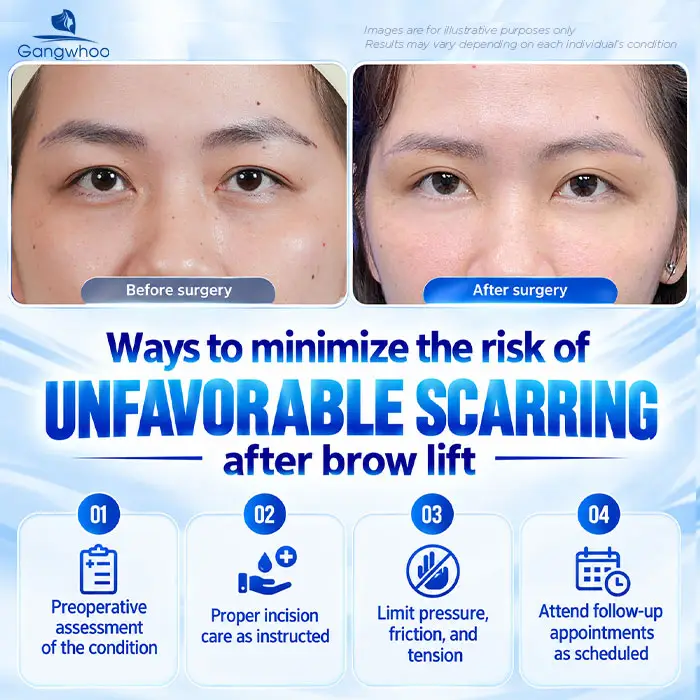
The first step is an accurate pre-operative assessment.
The doctor needs to evaluate the degree of brow ptosis, the condition of the forehead and upper eyelid skin, the position of the hairline, soft tissue quality, and each individual’s scarring history. Only then can the appropriate technique be determined.
After surgery, clients need to follow wound-care instructions. Do not pick at scabs, pull, or rub the surgical area. Physical activity and any movements that could stretch the incision area also need to be controlled according to the doctor’s guidance.
Doctors at Gangwhoo Cosmetic Hospital advise clients to follow post-operative instructions and avoid applying force, friction, or excessive movement to the incision during the healing phase.
In addition, attending follow-up appointments on schedule allows the doctor to monitor the healing process and detect any abnormal signs early.
Who Should Pay Special Attention to Scarring Risk?
If you have previously had a keloid or hypertrophic scar, this is information that must be discussed before undergoing a brow lift.
In addition, people with health conditions or factors that could affect the healing process also need to be evaluated before surgery. Both the Cleveland Clinic and ASPS note that brow lift surgery can carry risks such as unfavorable scarring, infection, bleeding, changes in skin sensation, hair loss around the incision, or other healing-related complications.
Therefore, instead of only asking “Does Brow Lift Surgery Leave Scars?”, I advise clients to also ask:
“Given my anatomy and skin type, which incision approach is suitable for me, and what is my personal risk of scarring?”
This is the question that helps the doctor provide truly personalized advice.
How to Choose a Facility for Brow Lift Surgery to Minimize Scarring Risk
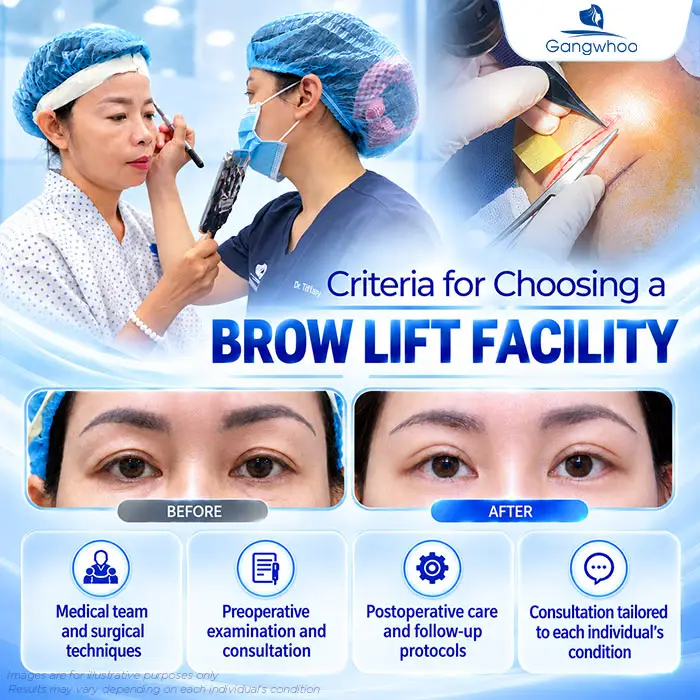
When choosing where to undergo the procedure, don’t rely solely on advertisements claiming “no scars” or “leaves no trace.” Instead, pay attention to who will actually perform the surgery, the technique indicated, the surgical protocol, and post-operative care.
A suitable facility should include a pre-procedure consultation to assess your actual condition. The doctor should clearly explain the treatment goals, the planned method, the incision location, possible risks, and post-operative care.
Most importantly, clients should receive advice based on their individual condition rather than having the same technique applied to everyone.
At Gangwhoo Cosmetic Hospital, the current specialty offerings include Brow Lift and Endoscopic Brow Lift among the eye-area aesthetic services.
If you’re considering the procedure, you can visit Gangwhoo to have a doctor directly examine and assess the condition of your eyebrows, eyelids, forehead, and soft tissue characteristics before choosing a method.
Photos of Clients Who Underwent Brow Lift Surgery at Gangwhoo Cosmetic Hospital
Brow lift surgery can leave a scar, but that doesn’t mean every case will result in a clearly visible or unattractive scar.
How noticeable the scar is depends on many factors: the brow lift method, the incision location, the surgeon’s technique, individual scarring tendencies, and post-operative care. With the endoscopic technique, the incisions are typically small and placed within the scalp, which can help conceal the scar more effectively.
Most importantly, you shouldn’t choose a service based solely on “no scar” advertising claims. An appropriate treatment plan should be developed only after a doctor conducts a direct examination and a thorough assessment of the eye – brow – forehead area.
If you’re considering a brow lift and are concerned about scarring, you can schedule a consultation at Gangwhoo Cosmetic Hospital to have a doctor assess your specific condition, explain the incision location, and choose the method best suited to your anatomy and aesthetic goals.