
Sunken temples are one of the factors that make the face look hollow, older than the actual age, and lacking fullness and a gentle appearance. In clinical practice, I meet many patients who ask the same question: Should I choose temple implants, filler injections, or fat grafting?
This is a very valid question, but also one that cannot be answered with a single universal solution. Each temple augmentation method has a different medical nature, indication, advantages, disadvantages, and level of suitability depending on the individual.
This article will help you clearly understand each method from a medical perspective, so you can determine whether temple implants, filler injections, or fat grafting are the right choice for your condition.
Why are so many people unsure whether to choose temple implants, filler injections, or fat grafting?
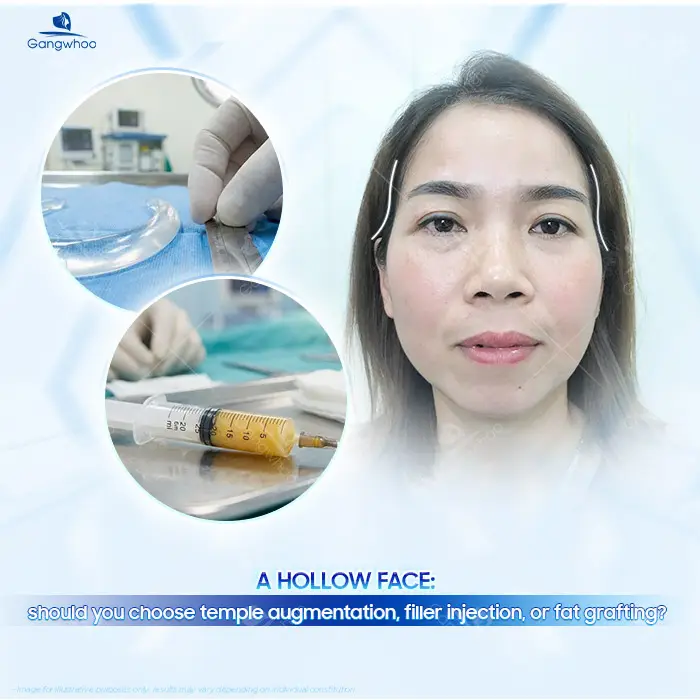
The temple area is anatomically sensitive, involving bone structure, soft tissue, and a complex vascular system. When this area becomes hollow, the face loses balance, the outer corners of the eyes may droop, and the overall appearance looks tired and less vibrant.
Currently, there are three main methods to correct sunken temples: temple filler injections, temple fat grafting, and temple implants. All three can improve temple hollowing, but not every method is suitable for every degree of hollowing or every individual’s anatomy.
Therefore, it is completely understandable that many patients feel uncertain.
What are temple filler injections? When should you choose them?
Temple filler injections involve using dermal fillers, most commonly Hyaluronic Acid (HA), to restore volume to sunken temples. HA fillers are highly biocompatible and widely used in modern aesthetic medicine.
Mechanically, fillers provide immediate volume replacement, improving temple contour and facial balance. This is a non-surgical procedure with quick execution and almost immediate visible results.
However, fillers are not permanent. According to medical studies and clinical guidelines, HA fillers in the temple area typically last 12 to 18 months, depending on the product used, injection technique, and individual metabolism. After that, the filler gradually dissolves and requires maintenance injections.
One very important point I always emphasize is that temple filler injections are not a simple procedure. The temple area contains complex blood vessels, and incorrect injection depth or technique can lead to serious complications such as vascular occlusion, skin necrosis, or even visual impairment in rare documented cases.
Therefore, temple filler injections are only suitable for mild temple hollowing, patients seeking quick, temporary improvement, and must be performed by a doctor with advanced anatomical knowledge.
What is temple fat grafting? Is it a good option?
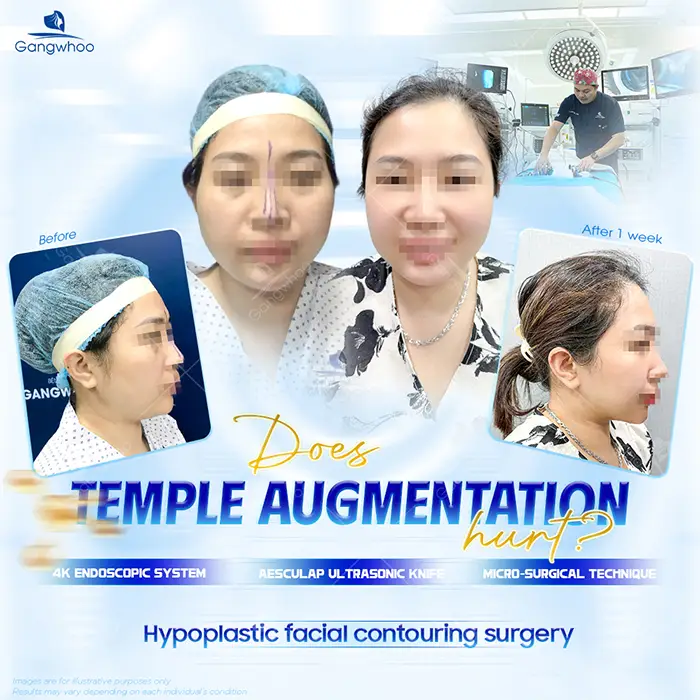
Temple fat grafting uses autologous fat harvested from the patient’s own body (commonly the abdomen or thighs), which is then processed and injected into the sunken temple area.
The greatest advantage of fat grafting is the use of the patient’s own tissue, offering high biocompatibility and a soft, natural feel. If the fat survives well, results can be long-lasting and more stable than fillers.
However, medically speaking, it is important to understand that not all transferred fat cells will survive. Fat survival depends on harvesting technique, processing, injection method, recipient tissue quality, and individual physiology. Therefore, some patients may require additional touch-up sessions to achieve the desired volume.
Temple fat grafting is suitable for patients with moderate temple hollowing, sufficient donor fat, and a preference for natural, non-synthetic materials. Recovery time is usually longer than fillers, but the long-term feel is more natural.
What are temple implants? Should you choose them?

Temple implants are a surgical method that uses specialized implant materials to augment sunken temples. This approach is more invasive than fillers or fat grafting but provides the most stable and noticeable results for severe temple hollowing.
From a professional standpoint, temple implants allow surgeons to precisely control volume and contour. Results can be long-lasting if the implant is correctly positioned and post-operative care is properly followed.
However, because this is a surgical procedure, it requires a surgeon with strong expertise in facial anatomy and reconstructive techniques. Recovery time is also longer compared to fillers and fat grafting.
Temple implants are typically indicated for patients with severe temple hollowing and significant bony deficiency, or those seeking a long-term solution and willing to undergo surgery.
Comparison: Temple implants vs. filler injections vs. fat grafting – Which should you choose?
When comparing these three methods, there is no single “best” option—only the most suitable method for each individual’s anatomy and condition.
| Criteria | Temple Fillers | Temple Fat Grafting | Temple Implants |
|---|---|---|---|
| Nature of procedure | Injection of dermal filler (usually HA) | Harvesting and injecting autologous fat | Surgical placement of implants |
| Invasiveness | Non-surgical, minimally invasive | Moderately invasive | Surgical |
| Time to see results | Almost immediate | Gradual after swelling subsides | After surgical recovery |
| Longevity | Temporary | Relatively long-lasting if fat survives | Long-term, stable |
| Natural feel | Natural if injected correctly | Very natural due to autologous tissue | Depends on technique and implant quality |
| Recovery time | Short | Moderate | Longer |
| Limitations & risks | Not permanent, requires anatomical expertise | Partial fat resorption possible | Surgical risks, requires high expertise |
| Best suited for | Mild hollowing, quick temporary improvement | Moderate hollowing, natural preference | Severe hollowing, long-term correction |
In clinical practice, some cases require a combination of methods, such as implants for structural volume followed by fat or fillers for refinement. This decision must be based on direct clinical examination, not solely on photos or general advice.
Why do many patients choose Gangwhoo Aesthetic Hospital for temple augmentation?
Among temple augmentation methods, safety and long-term effectiveness depend not on the method itself, but on the surgeon’s expertise, medical protocol, and accurate indication assessment.
At Gangwhoo Aesthetic Hospital, every temple augmentation case is approached with a personalized medical perspective. Patients are examined directly by board-certified plastic surgeons who carefully assess temple hollowing severity, bone structure, soft tissue thickness, and skin condition before recommending the appropriate method.
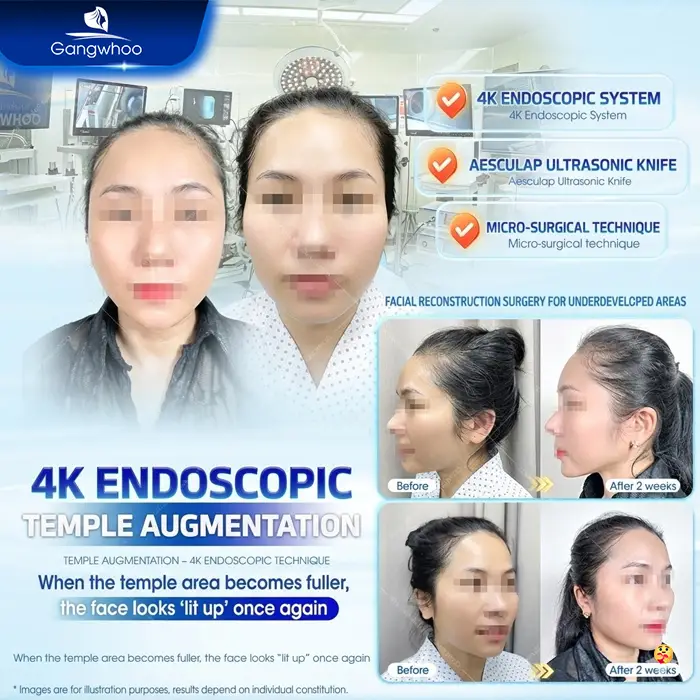
Gangwhoo does not apply a one-size-fits-all approach. Depending on the case, fillers may be recommended for mild hollowing, fat grafting for natural softness, or implants for severe structural deficiency. Complex cases may involve combined techniques based on clinical experience.
In addition, Gangwhoo invests heavily in sterile operating rooms, advanced medical equipment, and strict safety protocols—especially important for temple procedures, given the complex vascular anatomy of this area.
The commitment to medical safety as the top priority and individualized treatment planning is why Gangwhoo Aesthetic Hospital is trusted by many patients for temple augmentation.
Should you choose temple implants, filler injections, or fat grafting? This question has no universal answer. The correct choice depends on temple anatomy, individual physiology, and personal expectations. A direct consultation with a qualified plastic surgeon at Gangwhoo is essential to ensure both aesthetic results and long-term medical safety.