
In aesthetic plastic surgery practice, temple augmentation is a method used to improve sunken temples, creating a fuller and more youthful facial appearance. However, alongside successful cases, I also encounter a considerable number of patients with misaligned temple augmentation, resulting in facial asymmetry and significant concern. This complication may occur if the procedure or post-operative care is not performed according to medical standards and requires timely evaluation and appropriate management to ensure safety.
What Is Temple Augmentation and Why Can Implants Become Misaligned?
Temple augmentation is a technique in which suitable materials—such as autologous fat, dermal fillers, or synthetic implants—are placed into the hollow temple area to restore volume and enhance facial contours. Anatomically, the temple region contains numerous superficial blood vessels, nerves, and uneven soft tissue layers, requiring surgeons to have precise anatomical knowledge and accurate material placement.
Temple implants may become misaligned when the material is not properly secured, surrounding tissues provide insufficient support, or adverse factors occur during the healing process. Misalignment may appear early after surgery or develop later over time.
Causes of Misaligned Temple Augmentation
In clinical practice, misaligned temple augmentation rarely results from a single cause. Most cases arise from a combination of surgical technique, temple tissue characteristics, and post-operative care. Below are the most common causes.

1. Incorrect Anatomical Layer Placement or Inadequate Fixation
The temple area has a complex anatomical structure with multiple soft tissue layers and vascular networks. If augmentation materials (fillers, autologous fat, or implants) are placed in the wrong anatomical layer or not securely fixed, displacement may occur over time. This is the most common cause of misalignment, often seen in procedures performed by inexperienced practitioners or at facilities that do not meet medical standards.
2. Infection After Temple Augmentation
Infection is a serious complication that requires prompt treatment. Inflammatory reactions can damage surrounding tissues, disrupt structural support, and cause the implant to shift from its original position. In many cases, infection not only leads to misalignment but also necessitates complete removal of the material to ensure patient safety.
3. Trauma or Impact to the Temple Area After the Procedure
During the early post-operative period, the implanted material has not yet stabilized. Strong impact, pressure, or direct trauma to the temple area may cause displacement, leading to asymmetry. This is why patients are advised to avoid strenuous activities and protect the surgical site during recovery.
4. Thin Soft Tissue or Weak Structural Support
In some patients, thin soft tissue or weak structural support in the temple area makes implants more prone to visibility or displacement, even when proper technique is used. These cases require careful consideration of material type, volume, and fixation methods to minimize complications.
5. Capsular Contracture Around Synthetic Implants
In cases of temple augmentation using synthetic implants, capsular contracture may develop over time. Uneven fibrous capsule contraction can alter implant position or shape, causing asymmetry between the temples. This is a late complication that often requires corrective intervention.
6. Uneven Fat Resorption in Autologous Fat Grafting
With autologous fat temple augmentation, partial fat resorption is expected. If fat loss occurs unevenly between the two sides, temple asymmetry may develop, creating the appearance of misalignment even if initial results were satisfactory. In such cases, additional fat grafting may be considered.
Signs of Misaligned Temple Augmentation
Patients may notice uneven temples, with one side appearing more prominent or sunken than the other. Some cases involve persistent discomfort, pressure, prolonged pain, redness, or swelling of the overlying skin. The presence of discharge, pus, or fever is a warning sign of infection and requires immediate medical evaluation. Early detection allows for safer and more effective management.
Diagnosis and Evaluation Before Treatment
When managing cases of misaligned temple augmentation, surgeons must perform a thorough clinical examination and compare pre- and post-procedure images. In certain cases, imaging modalities such as CT scans or 3D imaging are indicated to precisely determine implant position, soft tissue damage, and signs of inflammation or infection. This step is essential to developing an appropriate treatment plan and avoiding unnecessary intervention.
Treatment Options for Misaligned Temple Augmentation
Treatment of misaligned temple augmentation must follow medical principles: accurate cause identification, severity-based management, and prioritization of tissue safety before aesthetics. Not all cases require immediate surgical intervention, and correction should not be attempted while inflammation persists.
1. Observation and Conservative Treatment for Mild Misalignment
For mild cases without pain, infection, or tissue instability, physicians may recommend observation combined with medical management, including anti-inflammatory medication, swelling control, and care instructions. Early invasive intervention is discouraged, as it may worsen inflammation or increase implant mobility.
2. Minimally Invasive Correction for Localized, Non-Infected Misalignment
In selected cases—especially after filler injection or fat grafting—minimally invasive adjustments such as volume balancing or non-surgical correction may be considered once tissues are stable and free from inflammation. These interventions require precise anatomical understanding to avoid vascular or nerve injury.
3. Removal of Material in Severe or Complicated Cases
When significant misalignment causes marked aesthetic deformity, persistent pain, or signs of infection (redness, warmth, discharge), material removal is mandatory. The primary goal is to eliminate the source of inflammation, debride damaged tissue, and control infection before considering aesthetic reconstruction. Delaying removal in infected cases increases the risk of tissue damage and long-term sequelae.
4. Recovery and Tissue Stabilization After Material Removal

Following material removal, the temple area requires sufficient time to heal—ranging from several weeks to months, depending on the severity of inflammation and tissue damage. Close monitoring, scar management, and reassessment of soft tissue structure are essential. Premature re-intervention may increase the risk of recurrent misalignment.
5. Secondary Correction or Reconstruction of the Temple Area
Once tissues are stable, surgeons may consider a more appropriate reconstructive approach. Depending on the case, this may involve changing materials, modifying techniques, or combining methods to achieve durable results. The goal is to restore aesthetics while ensuring proper anatomical placement and structural support.
6. Key Principles in Managing Misaligned Temple Augmentation
The most important principle is to avoid rushed, subjective decisions. Each case requires direct examination, comprehensive tissue assessment, misalignment severity evaluation, and risk analysis before treatment. Correct timing and appropriate methods are crucial for long-term safety and aesthetic success.
Why Does Temple Augmentation at Gangwhoo Aesthetic Hospital Minimize the Risk of Misalignment?

In plastic surgery, achieving properly aligned temple augmentation is not a matter of luck but the result of strictly controlled medical protocols—from consultation and material selection to surgical technique and post-operative monitoring. At Gangwhoo Aesthetic Hospital, each temple augmentation procedure follows these professional standards.
Surgeons conduct thorough examinations and accurately assess individual temple anatomy. Rather than applying a fixed placement approach, material positioning is customized based on the degree of hollowing, soft tissue thickness, and bone structure to prevent displacement.
Appropriate material selection based on medical indication is another critical factor. Mild hollowing with good soft tissue support may be treated with fillers or autologous fat, while deeper defects requiring long-term results may involve synthetic implants with precise sizing and fixation. Incorrect material choice or excessive volume—common causes of misalignment—are strictly avoided.
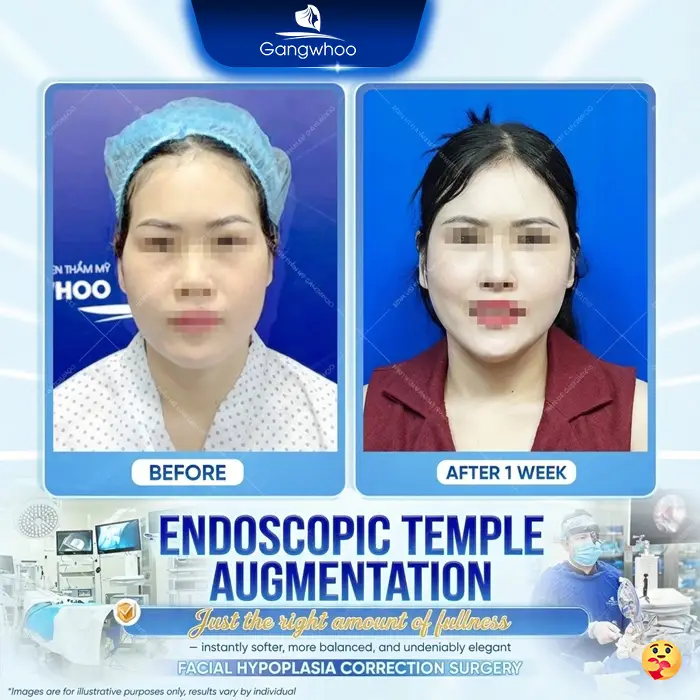
The procedure is performed in a hospital-standard sterile environment with rigorous infection control measures. Materials are placed in the correct anatomical layer and securely fixed to minimize post-procedure mobility.
Post-operatively, patients receive close monitoring and detailed care instructions. Scheduled follow-ups, inflammation control, and impact avoidance during early recovery help ensure long-term stability and reduce delayed misalignment.
From a professional standpoint, stable, non-misaligned temple augmentation results from the synergy of experienced surgeons, proper medical techniques, and comprehensive care protocols. This is why Gangwhoo Aesthetic Hospital is trusted for both primary temple augmentation and corrective procedures, delivering balanced, natural, and long-lasting results.
Misaligned temple augmentation is a manageable complication when evaluated and treated according to medical standards. Choosing Gangwhoo Aesthetic Hospital—with its experienced surgeons, strict safety protocols, and advanced technology—plays a vital role in achieving safe, natural, and stable temple augmentation outcomes.