
In clinical practice, I encounter many patients who have previously undergone temple augmentation but still wonder: can you get filler injections after temple augmentation, and whether doing so is safe or could affect the results of the prior surgery. This is a completely valid question, as the temple area has complex anatomy and carries significant risks if interventions are not performed with proper technique.
This article will help you clearly understand the issue from a medical perspective, based on anatomical principles, professional recommendations, and real-world treatment experience at the hospital.
Can You Get Filler Injections After Temple Augmentation?
The answer is not an absolute “yes” or “no”, but rather depends on each individual case.

From a medical standpoint, it is possible to inject fillers after temple augmentation; however, this is only appropriate under certain conditions and must be carefully evaluated by a board-certified plastic surgeon. Whether fillers can be used after temple augmentation depends on the previous augmentation method, the recovery timeline, soft tissue structure, and the remaining aesthetic goals.
In reality, fillers in this context are usually not a primary treatment but serve as a minor refinement tool, helping to soften contours or improve symmetry between the temples when surgical results have not fully achieved the desired harmony.
Understanding Temple Augmentation Methods and the Possibility of Subsequent Filler Injections
To determine whether filler injections are appropriate after temple augmentation, the original augmentation method must be considered.

With temple augmentation using implants (silicone or synthetic materials), the temple anatomy is significantly altered. The implant occupies space within the tissue pocket, reducing the safe area for filler placement. In these cases, filler injections require the physician to have precise knowledge of the implant’s location, the remaining tissue layers, and the vascular pathways. Incorrect injection depth may compress blood vessels and lead to serious complications. Therefore, not all patients with temple implants are suitable candidates for additional filler injections.
In contrast, with autologous fat grafting to the temples, the stabilized tissue closely resembles natural tissue. In some cases, after several months, if fat resorption is uneven or mild hollowing remains, a physician may consider fillers for fine-tuning. Even so, careful evaluation is required, as fat grafts and fillers have different properties, and excessive use may result in tissue firmness or an unnatural appearance.
Is It Dangerous to Inject Fillers into the Temples After Augmentation?

This is the most critical issue that anyone considering aesthetic treatment must understand.
The temple region is classified as a “high-risk area” for filler injections due to its dense vascular network, including branches directly connected to the ophthalmic artery. Numerous studies published on PubMed and in international plastic surgery journals have reported severe complications from temple filler injections, such as vascular occlusion, skin necrosis, and even irreversible vision loss.
These risks increase significantly in individuals who have previously undergone temple augmentation, especially with implants, because the original anatomy has been altered. Therefore, filler injections in this context are not a simple cosmetic procedure, but a medical intervention that requires advanced anatomical knowledge and strong experience in managing potential complications.
How Long After Temple Augmentation Can Fillers Be Injected?

According to medical principles, filler injections after temple augmentation should only be performed once the tissue has fully stabilized, with no active inflammation, swelling, or progressive fibrosis. In clinical practice, the following timelines may be used as reference.
For temple augmentation with implants (silicone or synthetic materials), the minimum waiting period is typically 3–6 months after surgery. This allows sufficient time for the surrounding soft tissue to heal, form a stable capsule, and reduce the risk of implant displacement. Injecting fillers earlier than this may increase the risk of inflammation, fibrosis, or implant compression, compromising both safety and aesthetic outcomes.
In cases of autologous fat grafting to the temples, fillers should only be considered once the fat has stabilized, usually after about 3 months, and ideally after 4–6 months. This period allows the physician to accurately assess fat retention, uneven resorption, and determine whether minor filler correction is necessary.
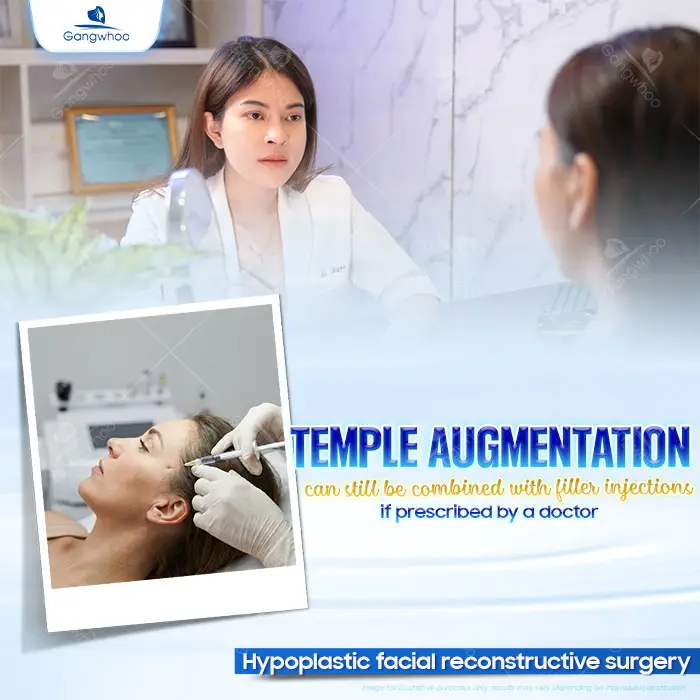
It must be emphasized that these timelines are for professional reference only and are not absolute for every patient. Prior to any filler injection, a direct clinical examination is required to assess tissue softness, implant position (if present), vascular status, and the patient’s specific aesthetic goals.
Most importantly, fillers should not be injected too early while the tissue is still unstable, as this can significantly increase the risk of infection, tissue hardening, contour irregularities, or serious vascular complications.
Safety Principles for Filler Injections After Temple Augmentation
In cases where filler injections are truly necessary after temple augmentation, I strictly adhere to rigorous medical safety principles.
The filler used must be hyaluronic acid (HA), which can be dissolved with hyaluronidase in the event of complications. Injection techniques must be anatomically precise, using minimal volumes, controlled injection pressure, and strict avoidance of direct injection over implanted materials. The procedure must be performed by a board-certified plastic surgeon with formal training and the ability to immediately manage complications if they arise.
Why Choose Gangwhoo Aesthetic Hospital for Filler Injections After Temple Augmentation?
For patients who have previously undergone temple augmentation or require filler injections afterward, choosing the right medical facility is crucial for both safety and long-term aesthetic outcomes. Clinical experience shows that most temple filler complications occur when procedures are performed at facilities that lack detailed surgical history or a deep understanding of altered anatomy.

At Gangwhoo Aesthetic Hospital, every temple augmentation and filler procedure is documented with comprehensive surgical records, including the method used, implant location (if any), tissue layers involved, and recovery progression. This is especially important when patients seek filler correction later, as it allows physicians to accurately evaluate current anatomy and design a safe treatment plan.
As the physician directly responsible for both the procedure and long-term follow-up, I strongly advise patients to continue treatment at the same hospital where the original temple augmentation was performed, rather than undergoing fragmented interventions at multiple facilities. This approach minimizes risks such as incorrect injection depth, implant compression, vascular injury, or difficult-to-manage complications.
Additionally, when fillers are injected after temple augmentation at Gangwhoo, patients are ensured the use of authentic, reversible fillers compatible with hyaluronidase, performed in a fully accredited hospital environment equipped with comprehensive emergency protocols. This is a mandatory requirement for high-risk areas such as the temples.
Most importantly, not every patient requires filler injections after temple augmentation. At Gangwhoo, physicians provide honest, individualized assessments, recommending additional treatment only when truly necessary, always prioritizing medical safety over aesthetic trends.
Can you get filler injections after temple augmentation? This question must be evaluated based on medical expertise, anatomical conditions, and each patient’s treatment history—it cannot be answered with a one-size-fits-all approach. Filler injections after temple augmentation should only be performed when truly indicated, at the appropriate time, and by a qualified specialist following direct examination and consultation. To ensure safety and long-term harmonious aesthetic results, patients should choose Gangwhoo Aesthetic Hospital, where complete surgical records, experienced physicians, and standardized medical protocols allow temple augmentation and post-augmentation filler injections to be performed accurately, safely, and under full control.