
Still wearing braces but the face hasn’t become as slim as hoped—especially when the jaw angle remains wide or square—is a situation that leaves many people puzzled. Many expect that once the teeth are aligned and the bite improves, the facial contours will change noticeably as well. However, when they notice the lower jaw is still broad or the jaw angle is still large, they start wondering whether jaw contouring surgery can be combined with braces to improve their facial features.
This is why the question “can I have jaw contouring surgery while wearing braces?” has become a topic of interest for many people. In particular, those currently undergoing orthodontic treatment often worry about whether jaw bone surgery could affect their teeth, their bite, or disrupt their existing braces treatment plan.
According to Dr. Nguyen Minh Hien, Level II Specialist in Odonto-Stomatology, wearing braces does not automatically rule out jaw contouring surgery. However, this isn’t a decision that can be made based on facial shape alone. The doctor needs to simultaneously assess the condition of the teeth, the bite, the jawbone structure, and the progress of orthodontic treatment to determine whether the patient truly needs bone surgery, as well as the most suitable timing.
So if you’re wearing braces and considering jaw contouring, the first priority isn’t finding a “yes or no” answer, but rather identifying what’s actually causing your face to not yet have the shape you want, and choosing a treatment approach suited to your specific condition.
Can I have jaw contouring surgery while wearing braces?
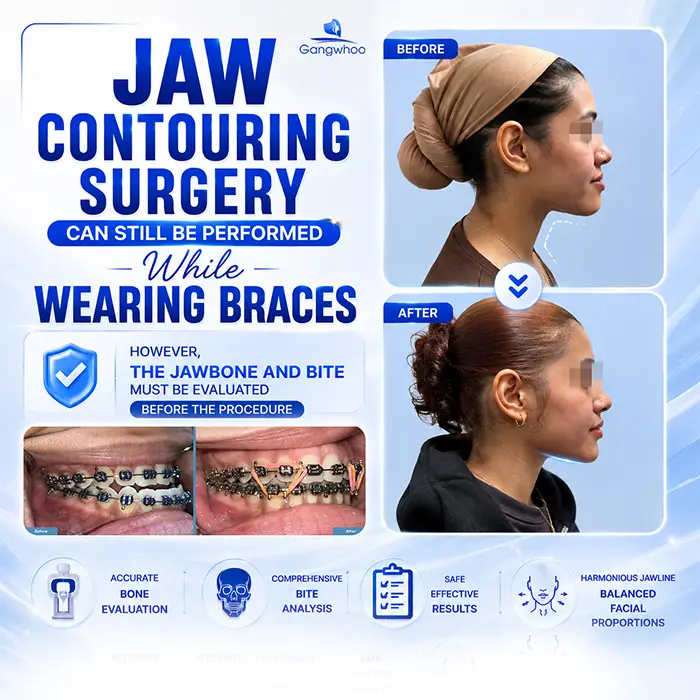
The short answer is: it’s possible, but only with a doctor’s evaluation and specific recommendation.
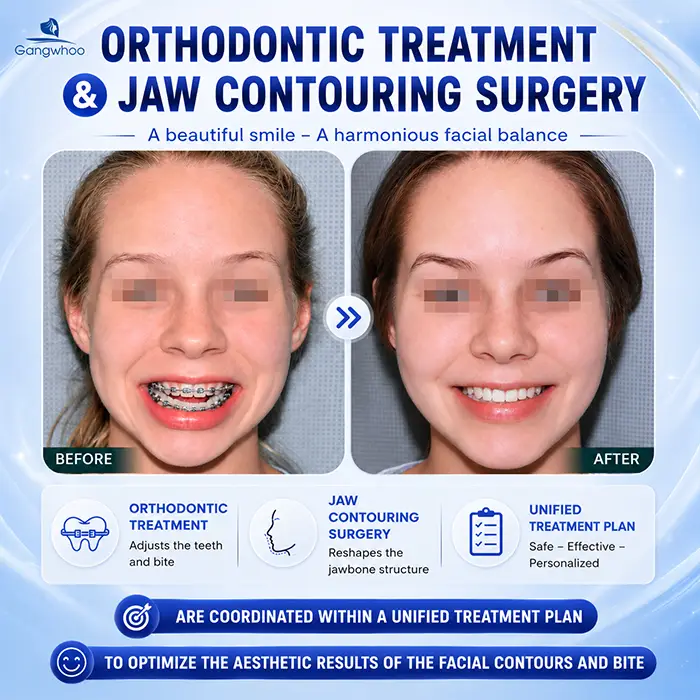
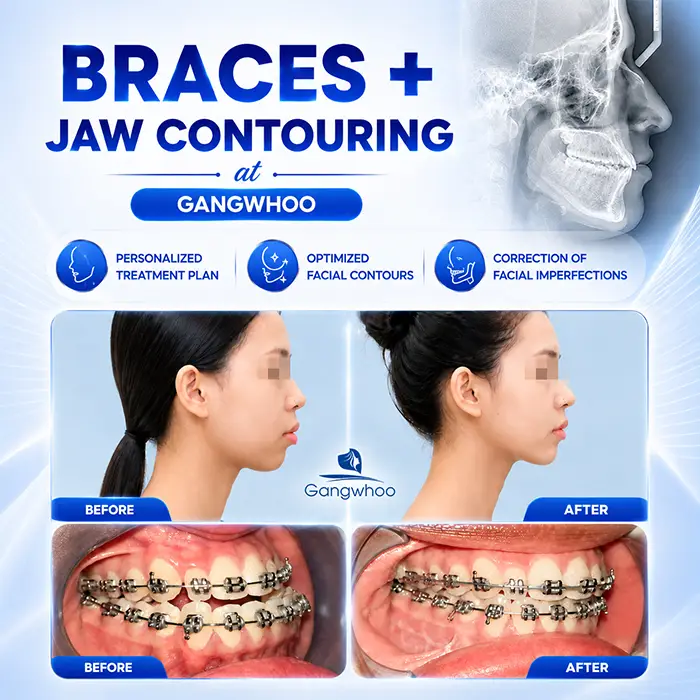
Braces and jaw contouring are two treatments with different goals and mechanisms. Braces focus on adjusting the position of the teeth, the dental arch, and the bite relationship. Jaw contouring, on the other hand, is a surgical procedure that directly intervenes in the jaw’s bone structure to reshape the jawline and jaw contour.
Therefore, simply wearing brackets or clear aligners isn’t the only factor determining whether jaw contouring is possible.
During an examination, the doctor needs to know what stage of orthodontic treatment the patient is in, how far the teeth have been aligned, what the current bite looks like, and what the plan for further tooth movement is going forward.
At the same time, the jawbone structure needs to be assessed to determine whether the wide or square jaw actually originates from the bone itself.
So if you’re wearing braces and considering jaw surgery, you shouldn’t choose the timing of surgery on your own, based only on how your face currently looks.
Why shouldn’t you decide on jaw contouring on your own while wearing braces?
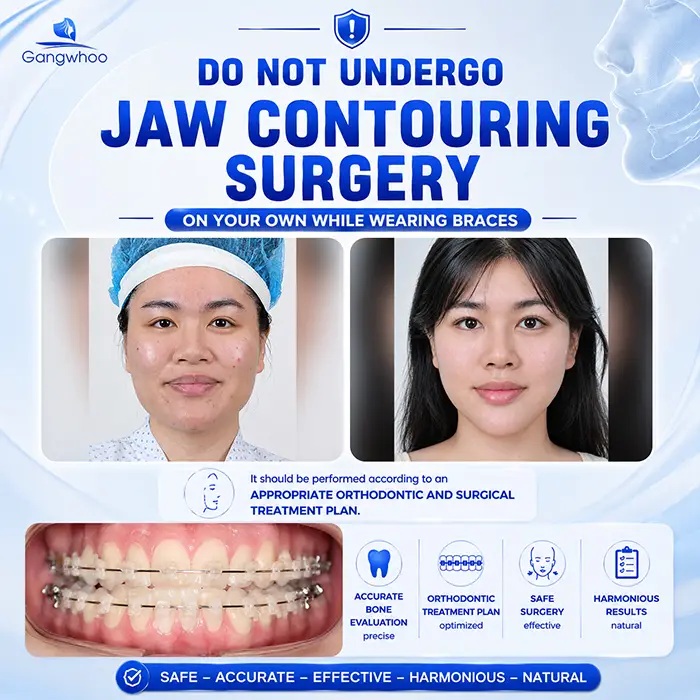
What matters most isn’t whether the patient is wearing braces, but the coordination between the orthodontic plan and the surgical plan.
During orthodontic treatment, tooth position can continue to change. If the final orthodontic goal isn’t yet clear and jawbone surgery is performed anyway, evaluating the resulting facial appearance and bite afterward can become more complicated.
Another common case is patients assuming a square face means a large jawbone. In reality, facial shape is influenced by many factors. Some people have a wide face due to bone structure; others have well-developed chewing muscles or soft-tissue proportions that make the jawline appear larger.
So before deciding on jaw contouring, one key question needs to be answered:
“What exactly is causing my face to look unbalanced?”
Correctly diagnosing the cause must always come before choosing a treatment method.
How are braces and jaw contouring different?
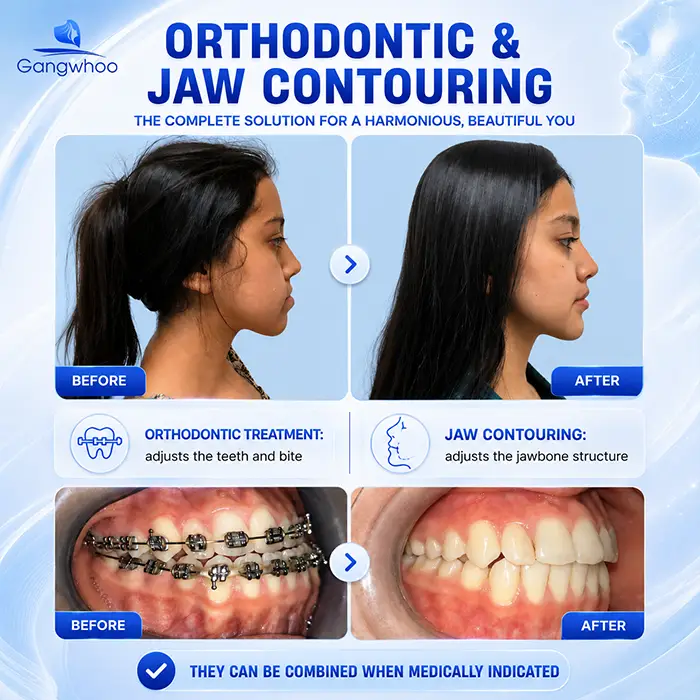
Many people tend to see braces and jaw contouring as interchangeable treatments. Professionally speaking, this isn’t accurate.
Braces primarily adjust tooth position and bite relationship. The goal of orthodontics isn’t simply to straighten teeth but also to achieve a stable bite and proper chewing function.
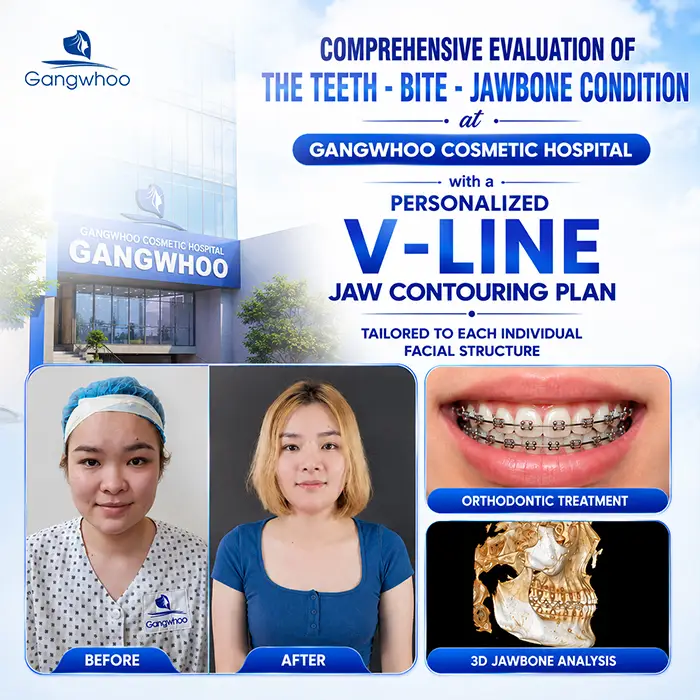
Jaw contouring, meanwhile, is a bone-reshaping surgery. According to Gangwhoo Plastic Surgery Hospital’s professional materials, V-Line jaw contouring is a technique that intervenes in the lower jawbone to correct cases of a square jaw, a large jaw angle, or an unbalanced jawline.
So put simply:
Braces address issues related to the teeth and bite; jaw contouring addresses issues related to the jawbone structure, when medically indicated.
In some cases, both methods may be part of the same treatment plan, but they need to be coordinated rather than carried out independently.
When can someone wearing braces consider jaw contouring?
A patient wearing braces may be considered for surgery if, after evaluation, the doctor determines that the lower jaw shape genuinely needs improvement related to bone structure, and that the intervention fits with the orthodontic plan.
1. A large or broad jaw angle, or jawbone growth causing a square face
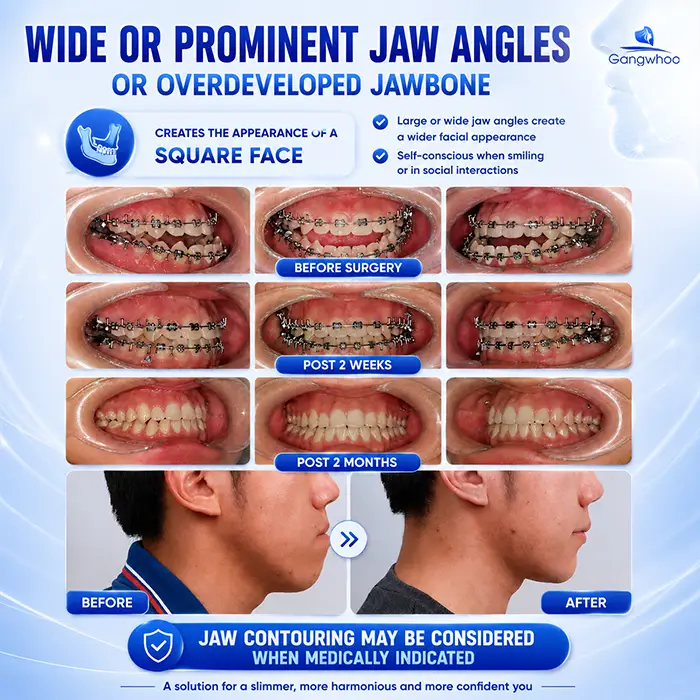
This is one of the cases patients most often ask about regarding jaw contouring.
However, the decision shouldn’t be made just by looking at the face with the naked eye. The doctor needs to assess bone structure and facial proportions before making a recommendation.
Gangwhoo’s materials state that the V-Line jaw contouring process includes a pre-operative examination and imaging diagnostics to analyze jawbone structure and facial proportions before surgical planning.
2. Teeth that are relatively stable and under control
Another factor to consider is the current state of orthodontic treatment.
The doctor needs to know how the teeth have been arranged, what stage the bite is at, and whether there are still major tooth movements planned in the treatment protocol.
There’s no universal timeline such as “braces for 3 months” or “braces for 6 months” that determines readiness for jaw contouring. Each case has different orthodontic goals.
3. Coordination between the orthodontist and the maxillofacial surgeon
This is a factor I pay particular attention to.
If a patient is undergoing orthodontic treatment at one facility but wants to have jaw surgery elsewhere, they need to provide treatment records, imaging, and information about their current protocol so the surgeon has a basis for evaluation.
At Gangwhoo, orthodontic documentation notes that the process includes imaging, bite analysis, tooth-jawbone axis analysis, and the development of a personalized treatment protocol.
When should jaw contouring be avoided while wearing braces?
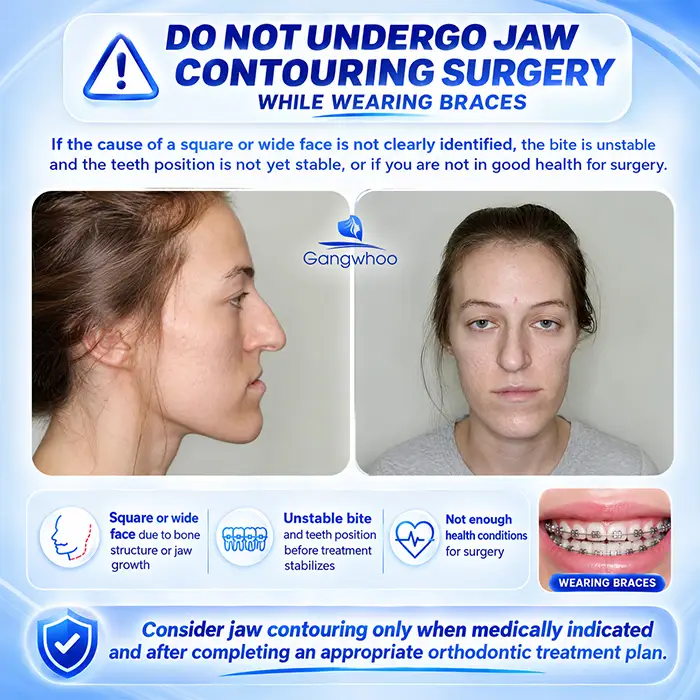
If the cause of a square or broad face hasn’t been identified yet, I don’t recommend patients rush into surgery.
In some cases, the face changes significantly during orthodontic treatment due to shifts in tooth position and lip-tooth relationships. If jaw contouring is done too early in such cases, it can be difficult to accurately assess the final appearance once orthodontic treatment is complete.
Similarly, if the bite is still undergoing major adjustment or the tooth-movement plan isn’t yet stable, the doctor needs to carefully consider the timing of any intervention.
Besides dental and jawbone factors, overall health also needs to be assessed before surgery. Gangwhoo’s process documentation describes steps including examination, testing, and evaluation of anesthesia suitability prior to surgery.
Should jaw contouring be done before or after braces?
This is a question I get fairly often, but there’s no single answer that fits every case.
1. Jaw contouring during orthodontic treatment
In some cases, surgery may be considered during orthodontic treatment if it aligns with the overall treatment plan.
The key condition is that the doctor must clearly understand the orthodontic goals, the current bite status, and the jawbone structure, in order to prevent the two treatment plans from negatively affecting each other.
2. Jaw contouring after completing orthodontic treatment
For some patients, finishing orthodontic treatment first allows the doctor to more clearly assess the outcome regarding teeth, bite, and facial shape before deciding whether bone intervention is needed.
However, this doesn’t mean that having jaw contouring after braces are removed is always better.
There are cases where the orthodontic and surgical plans need to be coordinated from the start in order to achieve the overall treatment goal.
3. So what’s the most suitable timing?
The most accurate answer is:
The appropriate timing for jaw contouring must be decided based on the orthodontic protocol, jawbone condition, bite, and treatment goals of each individual patient.
So you shouldn’t apply someone else’s experience directly to your own case.
Does jaw contouring during braces affect the orthodontic process?
There may be issues that need to be monitored and reassessed, depending on the specific case.
Before surgery, the doctor needs to understand the current tooth positions, bite relationship, and the plan for further orthodontic treatment. After surgery, the orthodontist also needs to monitor the actual condition to decide on the next treatment steps.
This doesn’t mean every case of jaw contouring requires removing the braces or completely changing the treatment protocol. But it also shouldn’t be assumed that surgery is entirely unrelated to the orthodontic process.
I often emphasize to patients that the ultimate goal isn’t just a slimmer jaw or straight teeth, but the overall result combining facial aesthetics, bite, and function.
Process for evaluating whether someone wearing braces is suitable for jaw contouring
A reasonable evaluation process should begin with an in-person examination.
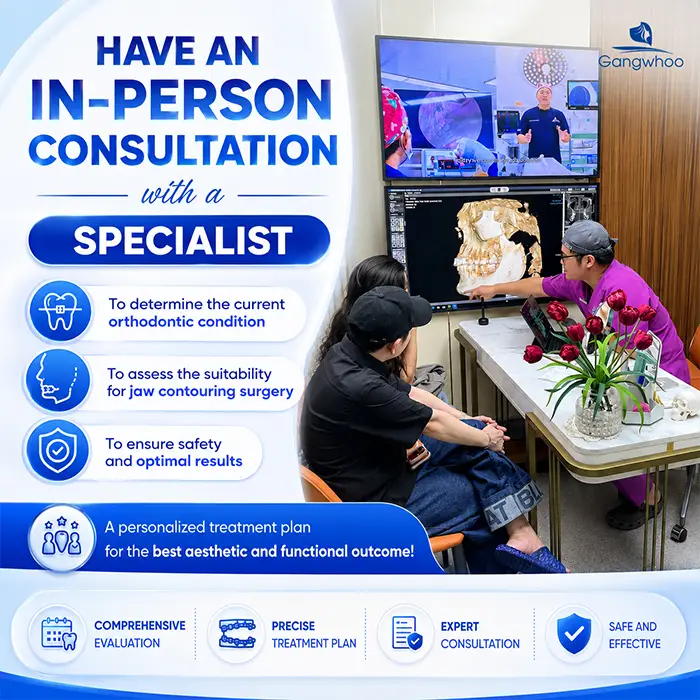
- Step 1: Examination and review of orthodontic history
The doctor needs to know what type of braces you’re using, how long you’ve been in treatment, and what your current orthodontic goals are.
- Step 2: Bite assessment
The bite needs to be checked along with the position and relationship of the teeth in both jaws.
- Step 3: Bone structure assessment
If indicated, the doctor will use appropriate imaging diagnostics to evaluate jawbone structure and related factors.
Gangwhoo’s documentation notes that a 3D computed AI X-ray system is used to help analyze jawbone structure, facial proportions, and plan the bone-cutting approach.
- Step 4: Overall facial analysis
The jaw angle shouldn’t be evaluated in isolation. The doctor needs to assess the balance between the jaw, chin, cheekbones, and the different facial zones.
- Step 5: Coordinating the treatment plan
If the patient is currently wearing braces, information from the orthodontist is essential for the maxillofacial surgeon to determine the appropriate timing for intervention.
- Step 6: Developing a personalized plan
Only once all the data is available can the doctor advise on whether jaw contouring is needed, and if so, when it should be performed and whether it should be combined with other methods.
Risks to be aware of when having jaw contouring while wearing braces
Jaw contouring is a bone surgery, so patients need to be fully counseled before making a decision.
Possible complications in maxillofacial surgery include pain, swelling, bruising, bleeding, infection, nerve damage, asymmetry, or complications related to anesthesia and the surgical procedure itself. The level of risk depends on the individual’s specific condition and the surgical technique used.
For patients wearing braces, in addition to surgical risks, the doctor also needs to monitor the bite and the orthodontic treatment plan.
Gangwhoo’s documentation describes a jaw contouring process involving an anesthesia and resuscitation team, pre-operative imaging diagnostics, bone intervention using specialized equipment, and post-operative monitoring at the hospital.
That said, I want to emphasize that no surgical method can ever be guaranteed to be risk-free. What matters most is that the patient is properly assessed, correctly indicated for the procedure, and treated at a facility with the appropriate expertise.
Where should someone wearing braces who wants jaw contouring go for a consultation?
For those wearing braces who are interested in jaw contouring, choosing a facility shouldn’t be based solely on before-and-after photos. Jaw contouring is a surgery that directly affects bone structure, so the surgeon needs to be able to comprehensively evaluate the teeth, bite, jawbone, and facial proportions, and have appropriate supporting systems for both planning and the surgery itself.
At Gangwhoo Plastic Surgery Hospital, maxillofacial contouring surgery is carried out with a personalized approach based on each patient’s bone structure and facial characteristics. With the V-Line jaw contouring technique, the process is supported by imaging diagnostic systems and specialized maxillofacial surgical equipment. The hospital’s professional documentation notes that a 3D computed AI X-ray is used to analyze jawbone structure and facial proportions, and to help determine the bone-cutting plan before surgery.
During surgery, a 4K endoscopic system helps magnify the surgical field, allowing the surgeon to better visualize anatomical structures during the procedure. According to Gangwhoo’s professional information, 4K endoscopy technology is applied to support precise maneuvers and limit unnecessary impact on surrounding tissue.
In addition, the German Aesculap bone-cutting system is used in the jawbone-reshaping technique. Gangwhoo’s jaw contouring process documentation notes that the Aesculap device is used together with 4K endoscopy during the bone-cutting stage of surgery. After reshaping, the bone structure is fixed using medical-grade titanium plates and screws to increase stability in the treated area.
Besides the specialized maxillofacial surgical systems, Gangwhoo also uses a Harmonic scalpel as part of the hospital’s surgical technology. According to the hospital’s technology documentation, the Harmonic scalpel is used in certain surgical techniques to support precise cutting and tissue control during the procedure. However, which device is used in a specific case depends on the technique, indication, and the surgeon’s judgment.
The key point for those asking whether jaw contouring is possible while wearing braces is that technology cannot replace a doctor’s diagnosis and clinical judgment. Before deciding on surgery, patients still need to be evaluated for their orthodontic status, bite, and jawbone structure. Once properly indicated, supporting systems such as AI Imaging, 4K endoscopy, and Aesculap play a role in assisting the doctor at every stage—from analysis and planning to performing the surgery.
For those wearing braces who also want to improve their jawline, I believe what matters isn’t finding the “latest” technology, but rather whether that technology is used for the right purpose, combined with an accurate diagnosis, and performed by a doctor with appropriate expertise. This is the real foundation for building a personalized maxillofacial treatment plan suited to each individual’s condition.