
Sunken temples are one of the features that make the face appear gaunt, less full, and older than one’s actual age. In modern aesthetic practice, autologous fat temple augmentation is considered a solution that restores volume to the temple area in a natural, safe, and harmonious way. With many years of experience directly performing facial fat grafting procedures, I find that this method is suitable for a wide range of patients when properly indicated and performed according to medical standards.

The article below will help you clearly understand the nature of autologous fat temple augmentation, the procedure, expected outcomes, potential risks, and important criteria for choosing a safe and reputable aesthetic facility.
What Is Autologous Fat Temple Augmentation?
Autologous fat temple augmentation, also known as temple fat grafting, is a procedure that uses the patient’s own fat to fill hollow or sunken temples. Fat is typically harvested from areas with excess fat such as the abdomen or thighs, then processed and selectively purified before being injected into the temple area using specialized techniques.

Anatomically, the temple is a region with complex soft tissue structures involving blood vessels and nerves. When this area becomes hollow, the face loses balance and vitality. Restoring volume with autologous fat not only corrects temple hollowness but also contributes to overall facial rejuvenation in a natural manner.
Why Is Autologous Fat Temple Augmentation Widely Chosen?

Compared to other methods, autologous fat temple augmentation offers a major advantage in terms of biological compatibility. Because the procedure uses the patient’s own tissue, the risk of rejection is virtually nonexistent. When performed with proper technique, the grafted fat integrates well and provides a soft, natural feel without stiffness or artificial appearance.
Additionally, this method improves overall facial harmony rather than simply filling a single area. For patients who also desire body contouring through liposuction, harvesting fat for temple augmentation offers the added benefit of body reshaping.
Medically Standardized Procedure for Autologous Fat Temple Augmentation
In aesthetic medicine, the procedural protocol plays a decisive role in determining safety, fat survival rate, and long-term outcomes of autologous fat temple augmentation. At accredited facilities, the procedure must be carried out systematically with clearly defined steps:

Comprehensive Consultation and Assessment
The physician conducts a thorough examination to assess the degree of temple hollowing, zygomatic–temporal bone structure, soft tissue thickness, skin condition, and overall facial proportions. Medical history, general health status, and necessary tests are reviewed to ensure the patient is a suitable candidate.
Determining the Appropriate Fat Volume and Donor Site
Based on the severity of temple hollowing, the physician calculates the required fat volume to achieve natural fullness while avoiding overcorrection. Fat is typically harvested from the abdomen or thighs, where fat quality is optimal for grafting.
Gentle Fat Harvesting with Low-Pressure Liposuction
Fat harvesting is performed using low-pressure liposuction techniques to minimize trauma and preserve viable fat cells. This step is critical for maximizing fat survival after grafting.
Fat Processing and Purification
The harvested fat is processed to remove impurities, blood, and excess fluids while selecting healthy fat cells. Proper processing enhances the fat’s ability to survive and integrate into the temple tissue.
Micro-Fat Grafting into the Temple Area
Purified fat is injected into the temple area using micro-grafting techniques, distributing the fat evenly across multiple tissue layers. This approach improves fat retention, reduces lumpiness, and results in a smooth, natural contour.
Continuous Monitoring Throughout the Procedure
The entire temple augmentation procedure is performed in a sterile operating room under strict supervision by experienced aesthetic surgeons and medical staff to ensure maximum safety.
How Long Does It Take for Autologous Fat Temple Augmentation to Stabilize?
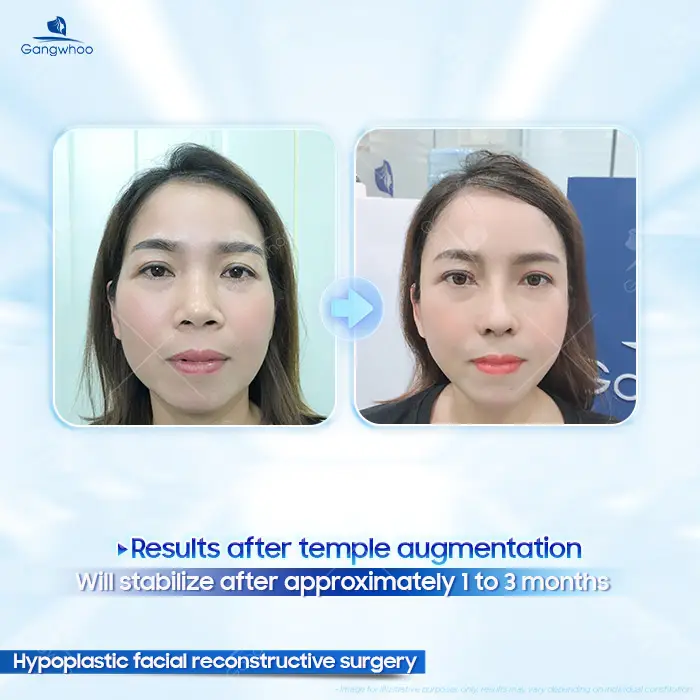
After autologous fat temple augmentation, patients often notice immediate fullness in the temple area. However, during the first few weeks, a certain degree of physiological fat resorption occurs. This is a normal response, as not all grafted fat cells successfully adapt.
Results typically begin to stabilize within 1–3 months and can be more accurately evaluated after 3–6 months. This timeline varies depending on individual physiology, grafting technique, and postoperative care.
Is Autologous Fat Temple Augmentation Permanent?
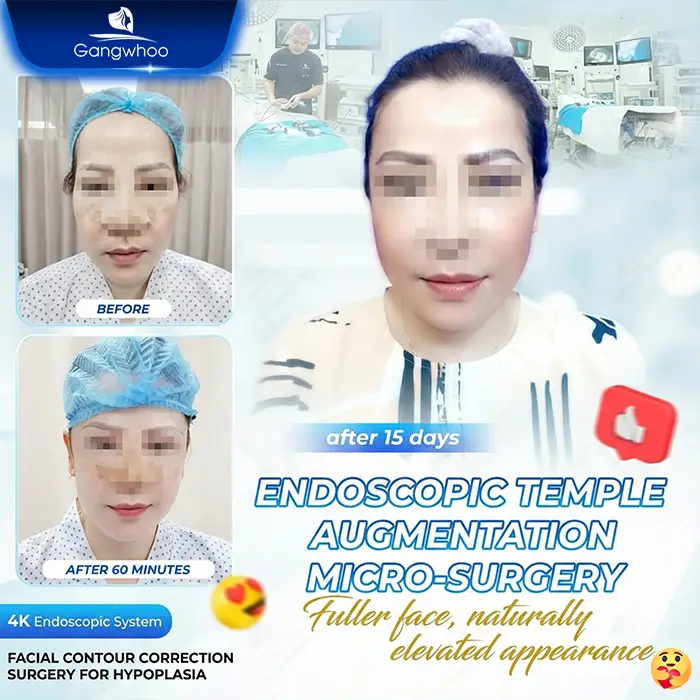
A common question is whether autologous fat temple augmentation is permanent. In practice, fat cells that survive after the stabilization phase can remain long-term, similar to natural fat tissue. However, the fat survival rate is never 100%.
Factors such as fat processing technique, injection method, individual healing response, and postoperative lifestyle all influence the final outcome. In some cases, a touch-up fat grafting session may be recommended to achieve the desired fullness.
Potential Complications of Autologous Fat Temple Augmentation
Although considered a safe procedure, autologous fat temple augmentation may still involve certain risks if not performed correctly. Possible complications include unevenness, excessive fat resorption, lump formation, or rare infections.
Most complications are related to practitioner skill and facility standards. Therefore, choosing a qualified surgeon and a licensed medical institution is essential to minimizing risks.
Postoperative Care After Autologous Fat Temple Augmentation
Postoperative care plays a crucial role in determining the fat graft survival rate and long-term stability of temple augmentation results. After grafting, fat cells require time to establish new microvascular networks (neovascularization), making adherence to postoperative instructions essential.
During the early recovery period, patients should minimize mechanical pressure on the temple area. Strong impact, compression, or premature massage may disrupt revascularization, leading to fat loss or uneven results. Mild swelling and tightness are normal physiological responses and typically subside within 7–14 days.
Patients should maintain proper sleeping positions, avoiding side sleeping or direct pressure on the temples during the first few weeks. Strenuous physical activities and actions that increase facial pressure should also be limited.
Nutrition plays a supportive role in recovery. Adequate intake of protein, vitamins, and minerals promotes tissue healing and regeneration. Patients should avoid alcohol, smoking, and stimulants, as these factors impair microcirculation and negatively affect fat survival.
Regular follow-up appointments as scheduled by the physician are essential. These visits allow early detection of issues such as excessive fat resorption, fluid accumulation, inflammation, or rare infections, enabling timely intervention.
Overall, proper care after autologous fat temple augmentation not only shortens recovery time but also optimizes aesthetic outcomes, ensuring a full, soft, and harmonious temple contour over the long term.
Who Is a Suitable Candidate for Autologous Fat Temple Augmentation?
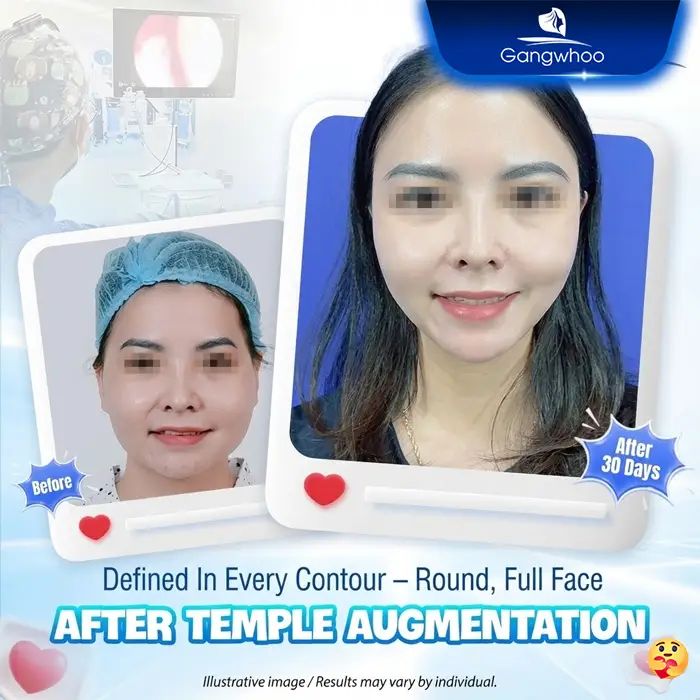
This method is suitable for individuals with mild to moderate temple hollowing who desire natural-looking facial enhancement. However, not all patients are immediate candidates. Those with underlying medical conditions or special health considerations require thorough evaluation before proceeding.
Autologous Fat Temple Augmentation at Gangwhoo Aesthetic Hospital
At Gangwhoo Aesthetic Hospital, autologous fat temple augmentation is performed as a specialized facial contouring procedure that requires close integration of expert medical assessment, advanced fat-processing techniques, and hospital-standard equipment. I personally evaluate each patient and collaborate with a team of board-certified aesthetic and reconstructive surgeons to design individualized treatment plans.
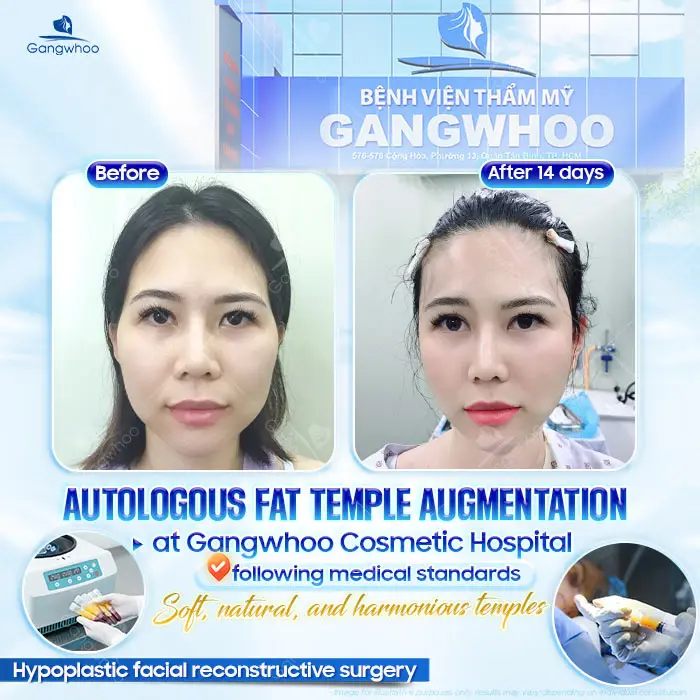
One of Gangwhoo’s strengths is the application of Lipo Ultrasound technology during fat harvesting. This technology selectively emulsifies fat using ultrasound waves, minimizing damage to fat cells and surrounding tissues. As a result, harvested fat is of higher quality, contributing to improved fat survival rates after grafting.
After harvesting, the fat is processed using a centrifugation system to remove impurities, blood, and excess fluids while isolating healthy fat cells. This step is critical for enhancing fat adaptation in the temple area, which demands high precision and aesthetic balance.
Fat grafting at Gangwhoo is performed using micro-injection techniques, distributing fat across multiple anatomical layers to achieve a smooth, natural, and harmonious temple contour. The entire procedure takes place in a sterile operating environment under strict medical safety protocols.
Postoperatively, patients receive close monitoring and detailed care instructions, along with a clear follow-up schedule to evaluate healing and fat stability. The comprehensive integration of expert surgeons, Lipo Ultrasound technology, advanced centrifugation systems, and structured postoperative care ensures that autologous fat temple augmentation at Gangwhoo Aesthetic Hospital achieves high safety standards and long-lasting results.
Conclusion
In conclusion, autologous fat temple augmentation is a highly regarded solution for restoring temple volume due to its safety, biological compatibility, and long-term natural results when properly indicated and performed. However, success largely depends on surgeon expertise, fat-processing protocols, and medical facility standards. Therefore, direct consultation at Gangwhoo Aesthetic Hospital—home to experienced specialists and advanced medical technology—ensures accurate facial assessment and selection of the most suitable, safe, and sustainable treatment approach.