
“What should I avoid eating after a brow lift?” is a question many clients ask after surgery. In particular, questions such as “Do I need to avoid beef, water spinach, chicken, or seafood?” often come up in the first days of recovery.
However, from a professional perspective, an absolute list of forbidden foods should not be applied to everyone who undergoes a brow lift. Post-operative diet should be considered based on the surgical technique, the condition of the incision, individual constitution, underlying medical conditions, allergies, and the guidance of the treating doctor.
At Gangwhoo Cosmetic Hospital, brow lift and endoscopic brow lift are part of the eye aesthetic services. Therefore, besides paying attention to which foods to eat or limit, patients should also focus on wound care, controlling swelling, and attending follow-up appointments on schedule.
Note: The content below is intended to provide reference information on post-brow-lift care and does not replace the individual instructions of the doctor who personally examined you and performed the surgery.
What should you avoid eating after a brow lift?
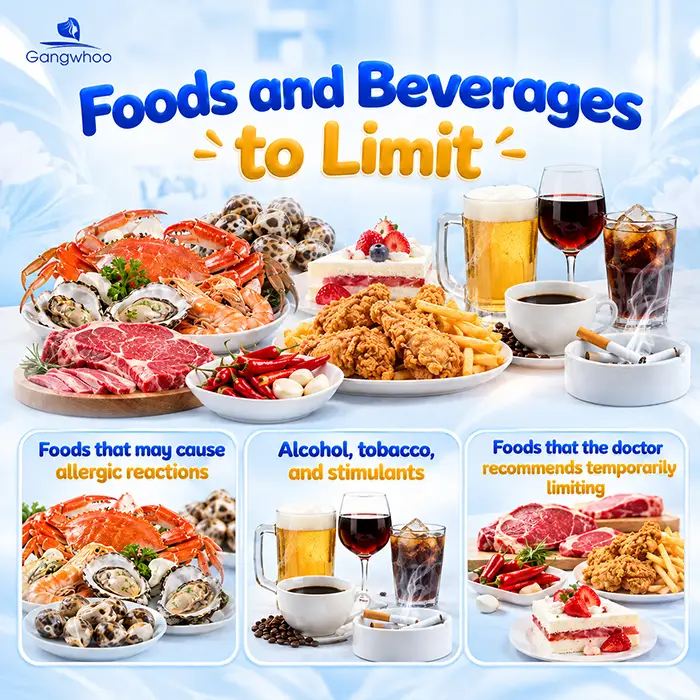
The short answer is: there is no absolute list of forbidden foods that applies to every brow lift case.
After surgery, the body enters the wound-healing process. At this stage, what matters is not only “which foods to avoid” but also ensuring appropriate nutrition, keeping the surgical area clean, and strictly following post-operative instructions.
Post-brow lift care materials also emphasize that diet should be personalized according to the doctor’s guidance. You should not apply a fixed list of dietary restrictions to every technique and every patient.
Therefore, instead of worrying too much about a specific dish, people who have just had a brow lift should focus on three main things: getting adequate nutrition, avoiding foods or drinks you are allergic to or that your doctor has asked you to limit, and caring for the incision properly.
What should you limit after a brow lift?
1. Foods that have previously caused allergies or intolerance
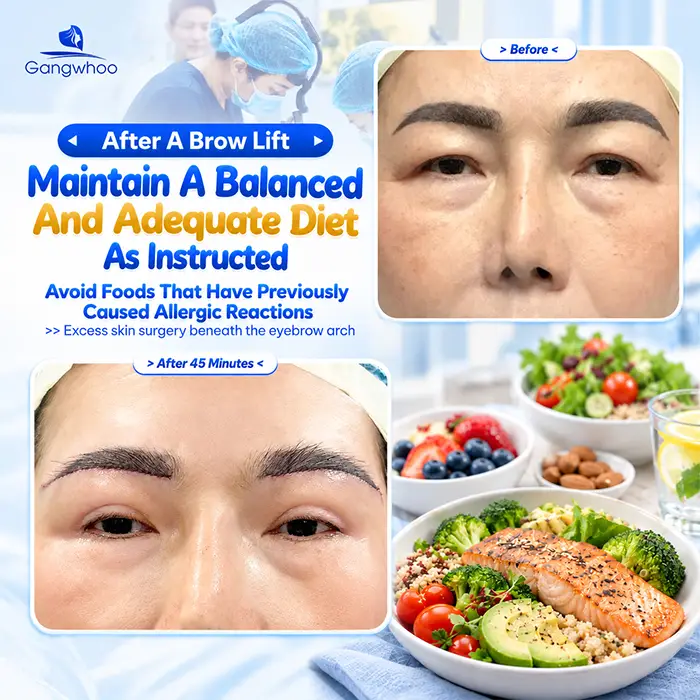
If you have a history of allergy to a certain food, this is not the right time to try it again.
Allergic reactions can cause discomfort and make it more complicated to monitor your post-operative condition. Therefore, prioritize familiar foods that are easy to tolerate and suitable for your health condition.
2. Alcoholic beverages and stimulants
During the post-operative period, patients should follow the doctor’s instructions regarding alcohol, tobacco, and other stimulants.
Do not assume that a certain drink “doesn’t affect the incision” just because it doesn’t cause immediate pain. Post-surgical care should be considered as a whole, including current medications, the condition of the wound, and any underlying medical conditions.
3. Foods the doctor asks you to temporarily limit
In some cases, the doctor may give specific dietary instructions based on the patient’s actual condition.
Therefore, if the doctor who performed your brow lift asks you to temporarily limit certain foods, follow that instruction rather than lists found online.
Do you need to avoid beef after a brow lift?
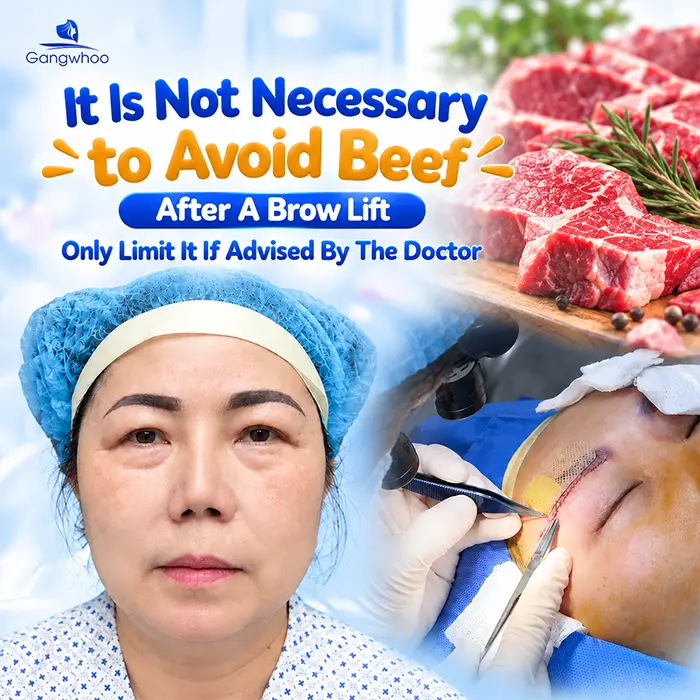
Can you eat beef after a brow lift? is a very common question.
In reality, it should not be assumed that everyone must avoid beef for a fixed period after a brow lift. Whether you need to limit it depends on your specific condition and the doctor’s guidance.
If your doctor tells you to avoid beef during the recovery period, follow that instruction. Conversely, if there is no special requirement, a folk belief should not be turned into a mandatory medical rule.
More importantly, the post-operative diet should provide adequate nutrition, and too many food groups should not be eliminated unnecessarily.
Can you eat water spinach after a brow lift?

Water spinach is often mentioned in lists of foods to “avoid after surgery,” mainly due to concerns about scarring.
However, according to the currently available professional information on post-brow-lift care, there is no absolute list of forbidden foods that applies to all cases.
Therefore, it should not be asserted that eating water spinach after a brow lift will definitely cause keloid scars or make the incision look worse.
The risk and characteristics of scar formation are also related to many other factors, such as surgical technique, incision location, tissue quality, individual scarring tendency, and post-operative care. People with a history of abnormal scarring should discuss this directly with their doctor.
Can you eat chicken after a brow lift?
Similar to beef and water spinach, a general rule that everyone must avoid chicken after a brow lift should not be made.
If you have no history of allergy, no digestive problems, and your doctor does not ask you to limit it, food choices should be based on a balanced diet.
If you are being monitored by a doctor after surgery and have received specific instructions about chicken, follow those instructions.
The important thing is not to let excessive worry about “avoiding” foods make your diet nutritionally poor.
Do you need to avoid seafood after a brow lift?

Seafood is a food group that requires special attention for those with a history of allergies.
If you have previously been allergic to shrimp, crab, fish, or a particular type of seafood, you should avoid that food and inform your doctor if necessary.
Conversely, it should not be assumed that seafood must be avoided by everyone after a brow lift.
What matters is distinguishing between contraindications or restrictions based on personal condition and word-of-mouth dietary lists found online.
What should you eat after a brow lift to support recovery?

Instead of focusing only on the question “what should you avoid eating after a brow lift,” patients should pay more attention to building a complete and suitable diet.
During recovery, the body needs appropriate nutrition to support normal physiological activities and the wound-healing process.
A diet can prioritize familiar, easy-to-tolerate, and varied food groups such as protein-rich foods, vegetables and fruits, suitable sources of starch, and sufficient water.
Protein is found in many foods such as meat, fish, eggs, milk, dairy products, or some plant-based sources. Which type to choose should depend on each person’s health condition, portion size, and tolerance.
Vegetables and fruits can also be reasonably included in the diet to supply vitamins, minerals, and fiber.
There is no need to turn the post-operative diet into an overly strict menu. The goal is to eat enough, eat a variety of foods, and follow the doctor’s guidance.
How long should you avoid certain foods after a brow lift?
If you are looking for a specific answer to the question “How long should I avoid certain foods after a brow lift?”, you can refer to a timeframe of roughly the first 2–4 weeks after surgery for foods that the doctor asks you to temporarily limit.
This is the period in which the body is going through the healing process, and the surgical area still needs careful monitoring and care. However, 2–4 weeks is not a mandatory restriction period that applies to all brow lift cases. The actual duration may vary depending on the surgical technique, the condition of the incision, the speed of recovery, individual constitution, and the doctor’s instructions.
Therefore, it can be understood simply as follows:
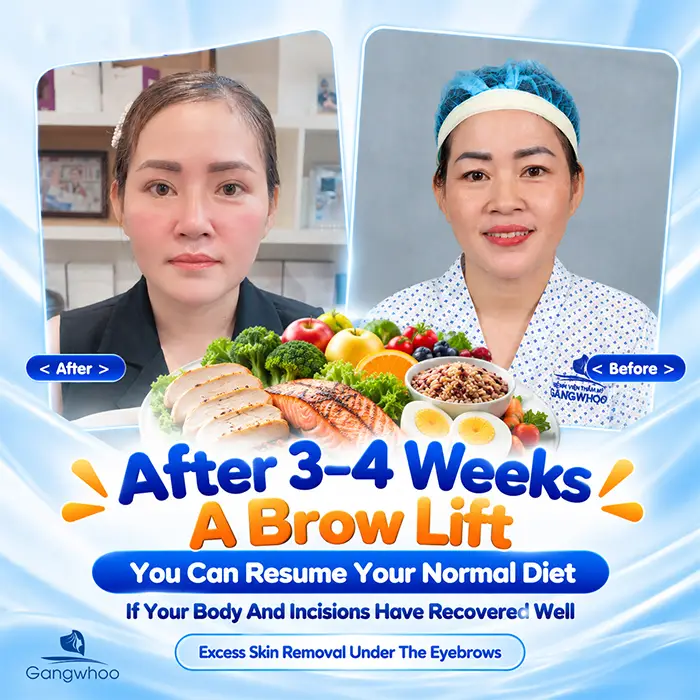
- First 1–2 weeks: prioritize a nutritionally complete, easy-to-digest diet, avoiding foods you are allergic to or those your doctor asks you to limit.
- Around weeks 3–4: if the incision is progressing well and the doctor assesses that recovery is stable, your diet can usually gradually return to normal under individual guidance.
- After 4 weeks: if there is still swelling, the wound has not completely healed, or any abnormalities appear, do not end the restrictions on your own; consult your treating doctor.
The key point is that “avoiding certain foods for 2–4 weeks” should not be understood as having to eliminate a whole range of foods such as beef, chicken, water spinach, or seafood throughout this period. The post-brow-lift care materials from the currently available professional source also do not provide an absolute list of forbidden foods applicable to all patients.
What if you accidentally eat something you should avoid after a brow lift?
If you accidentally eat something you were told to limit, do not panic immediately or take medications, supplements, or “swelling-reducing, scar-healing” products on your own that have not been prescribed by the doctor.
First, determine exactly what you ate, how much, and whether your body is showing any abnormal symptoms.
If there are no abnormal signs, continue to monitor and return to your diet according to the doctor’s instructions.
Conversely, if abnormal signs appear at the surgical site or systemic symptoms develop, contact your treating doctor for a direct evaluation.
An important principle in post-operative care is not to self-treat with folk remedies or products advertised as quickly reducing swelling without an appropriate prescription.
Besides diet, what else should you pay attention to after a brow lift?
Diet is only one part of post-brow-lift care. Caring for the incision and monitoring post-operative progress are also very important.
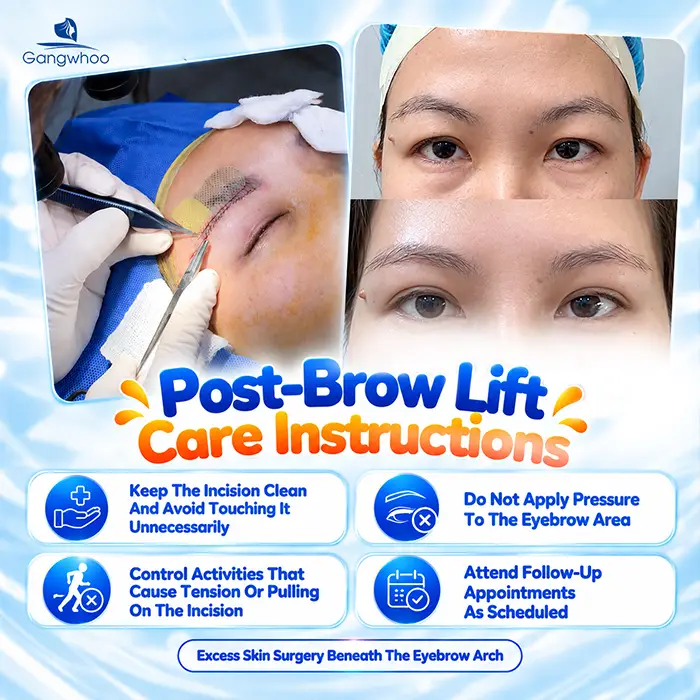
In the first few days, keep the treated area clean and follow the doctor’s hygiene instructions. Avoid constantly touching the wound with your hands, as this may increase the risk of infection.
Also, do not pull, rub, massage, or put pressure on the newly operated brow area on your own. Activities that may stretch the incision area should also be controlled according to post-operative instructions.
If the doctor schedules a follow-up appointment, patients should attend on time. Through direct examination, the doctor can assess swelling, the wound, the sutures, and the recovery process.
This is also why you should not rely only on images online to assess your own results. As swelling subsides, the shape of the brow may gradually become clearer, but the soft tissues still need time to stabilize.
Regarding the question “What should I avoid eating after a brow lift?”, the most important point is not to understand post-operative care as a list of forbidden foods that applies to everyone.
After a brow lift, your diet should be built on your health condition and the individual guidance of your doctor. Instead of excessive restriction, patients should focus on suitable nutrition, keeping the incision clean, limiting impact on the surgical area, and attending follow-up appointments on schedule.
In particular, if you experience progressively increasing swelling, severe pain, redness and warmth, abnormal discharge, prolonged bleeding, or fever, contact your treating doctor for a direct evaluation.
If you are considering a brow lift at Gangwhoo Cosmetic Hospital, visit in person so the doctor can assess your brows and your forehead and eyelid area, and advise on the appropriate method and post-operative care plan for your case.