
Does cheekbone reduction cause facial sagging? This is one of the questions I am asked most often when consulting people with prominent cheekbones who are considering facial contouring surgery.
From a professional standpoint, I want to be clear that cheekbone reduction does not necessarily mean the face will sag. However, this surgery directly affects the structure of the zygomatic bone and arch, and it can also influence how the soft tissues of the cheek are supported and adapt afterward. Therefore, the risk of sagging must be assessed based on several factors: the amount of bone to be adjusted, the condition of the skin and soft tissue, the dissection technique, the bone fixation method, and postoperative care.
Some professional sources also note that cheek sagging is a possible risk after cheekbone reduction surgery, especially when soft tissue is extensively dissected or when the patient already has loose skin or abundant soft tissue.
At Gangwhoo Cosmetic Hospital, my view is that we should not look only at the bone to be reduced. Before making any recommendation, we must evaluate the overall relationship between bone, muscle, fat, skin, ligaments, and facial proportions.
Does Cheekbone Reduction Cause Facial Sagging?
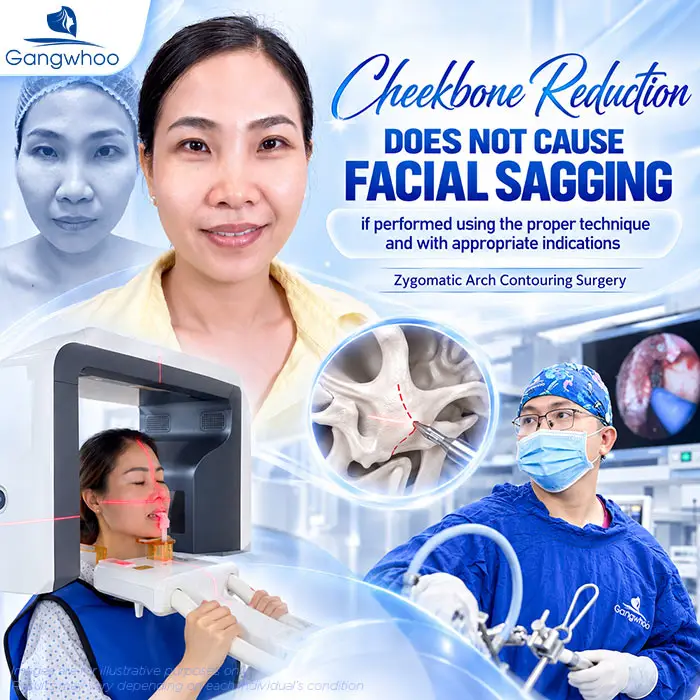
The answer I want to emphasize is this: when cheekbone reduction is performed with the right indication, the right technique, and at a reputable hospital, it should not cause facial sagging.
Cheekbone reduction is a maxillofacial bone-contouring surgery that adjusts the position and projection of the zygomatic complex and zygomatic arch. Depending on the individual’s anatomy, the surgeon may cut and reposition this bone to a more suitable location, then fix it in place with a system of maxillofacial plates and screws.
The key point is that this surgery is not performed using one formula for everyone. The surgeon must accurately determine how prominent the cheekbones are, how they relate to the middle and lower thirds of the face, and the condition of the soft tissue and skin elasticity before planning the procedure.
What worries many people is that once the underlying supporting bone is changed, the overlying soft tissues also need time to adapt. Facial soft tissue is not a simple layer of skin but a system of interrelated components, including skin, subcutaneous fat, fascia, muscles of facial expression, and supporting ligament structures.
Therefore, the goal of a high-quality cheekbone reduction is not simply “lowering the cheekbone” but ensuring harmony between the new bone structure and the soft tissue system covering it.
Why Can Cheekbone Reduction Cause the Cheeks to Sag?
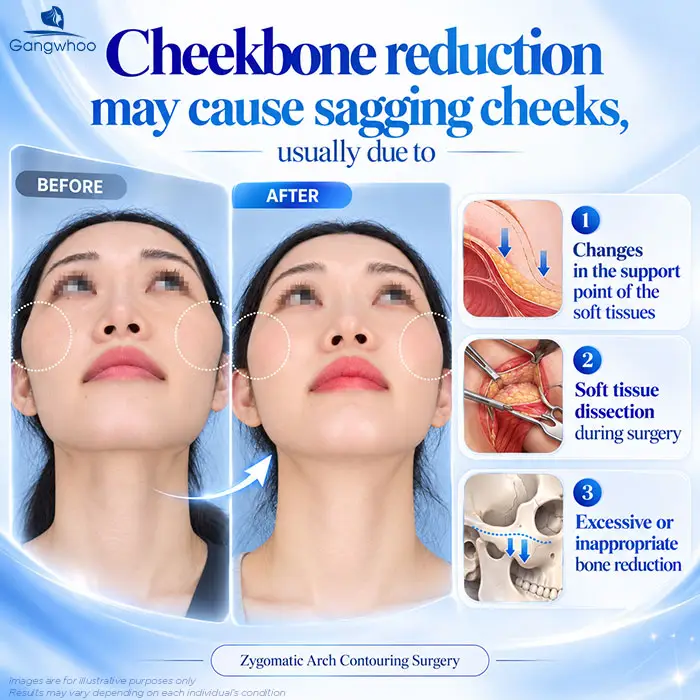
1. Change in the support points of the soft tissue
The cheekbone contributes to the projection of the middle third of the face and is part of the support system for the soft tissue of the cheek.
When surgery changes the position or projection of the zygomatic complex and arch, the overlying soft tissue must also adapt to the new bone shape. If the change in bone is too large relative to the patient’s soft tissue characteristics, or if the soft tissue is not handled appropriately, the cheeks may feel less firm or may droop slightly.
This explains why, even with the same cheekbone reduction procedure, postoperative results can differ from person to person.
2. Soft tissue dissection during surgery
To reach the cheekbone, the surgeon must create a surgical field and expose the bone to be treated. During this process, soft tissue may be separated from the bone surface to varying degrees.
According to professional information from Vinmec, cheek sagging after cheekbone reduction may be related to extensive detachment of tissue around the bone, including structures connected to the facial muscles. Therefore, controlling the extent of dissection and postoperative care are factors that need attention.
From a maxillofacial surgery perspective, I place particular importance on the principle of preserving soft tissue that does not need to be disturbed. A good operation must not only achieve the desired bone shape but also minimize unnecessary trauma to adjacent structures.
3. Excessive or unsuitable bone reduction
A common aesthetic misconception is that the more you reduce, the lower the cheekbones will be and the more beautiful the face will look.
In reality, this is not true.
Every face has a different bone structure, soft tissue thickness, and set of proportions. If the focus is only on reducing cheekbone projection without evaluating the face as a whole, the face may become unbalanced, appear hollow, or even look older.
Therefore, the degree of bone reduction must be individualized, based on clinical examination, facial analysis, and imaging when necessary.
Who Has a Higher Risk of Sagging After Cheekbone Reduction?
No single age or characteristic can accurately predict the risk of sagging. However, in practice, I pay particular attention to cases with one or more of the following factors.
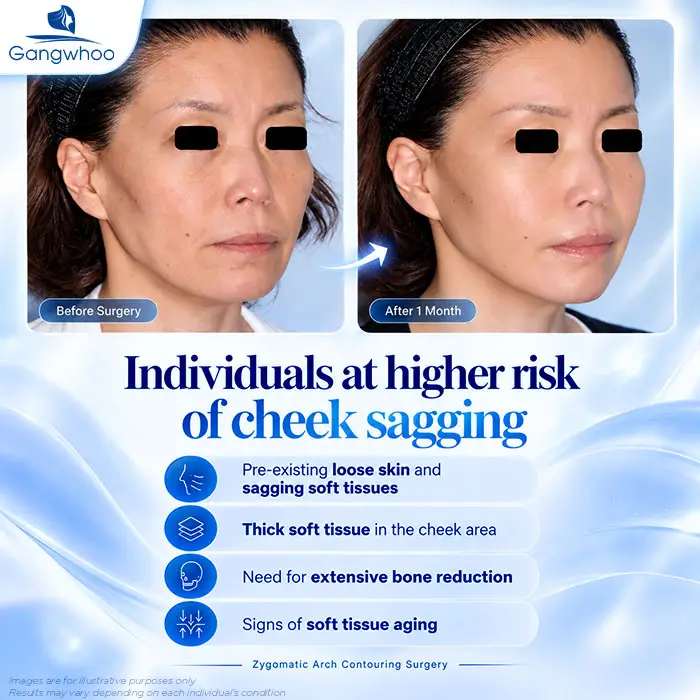
1. People who already have loose skin or drooping soft tissue
If the cheeks already show sagging before surgery, with reduced skin elasticity or relatively heavy soft tissue, adjusting only the cheekbone may not solve the entire aesthetic problem.
In some cases, the surgeon may consider additional treatments to address the soft tissue, but this decision must be based on an actual examination and should not be applied mechanically to every patient. Vinmec also notes that people with sagging skin or abundant soft tissue may be considered for a combined soft-tissue approach, depending on the case.
2. People with relatively thick cheek soft tissue
Two people with the same cheekbone shape can have completely different amounts of overlying soft tissue.
Therefore, when planning cheekbone reduction, the surgeon should not look only at images of the bone but should also evaluate the soft tissue and facial proportions.
3. People who need a large amount of bone adjustment
The greater the change to the bone structure, the more precise the surgical planning must be.
The goal is not to create the “lowest possible” cheekbone, but to bring the cheekbone structure to a position that suits the overall face.
4. People with signs of soft tissue aging
With age, collagen and elastin in the skin change, and soft tissue also undergoes changes in volume and elasticity. Therefore, a person who already shows soft tissue aging before surgery needs to be assessed differently from a young person with firm skin and stable soft tissue.
Signs of Sagging After Cheekbone Reduction vs. Normal Swelling
One thing I want to emphasize is that the results of cheekbone reduction should not be judged too early.
After surgery, swelling can temporarily change facial contours. Vinmec notes that swelling is usually most noticeable in the first week and decreases significantly over time, with substantial improvement typically after about one month.
So if, right after surgery, the cheeks look less slim, the face feels heavy, or the contours are not yet defined, you cannot conclude that the face is sagging.
Once swelling subsides, the surgeon will be better able to assess the soft tissue shape and the symmetry of both cheekbones.
Signs worth monitoring include a clearly drooping cheek area, a more prominent nasolabial fold, abnormal changes in the contour of the middle third of the face, or a significant difference between the two sides.
However, you should not self-diagnose a complication based only on what you see in the mirror. If you suspect something is abnormal, return for a follow-up so the doctor can examine you in person.
How to Reduce the Risk of Sagging After Cheekbone Reduction
In my view, prevention begins before you enter the operating room.
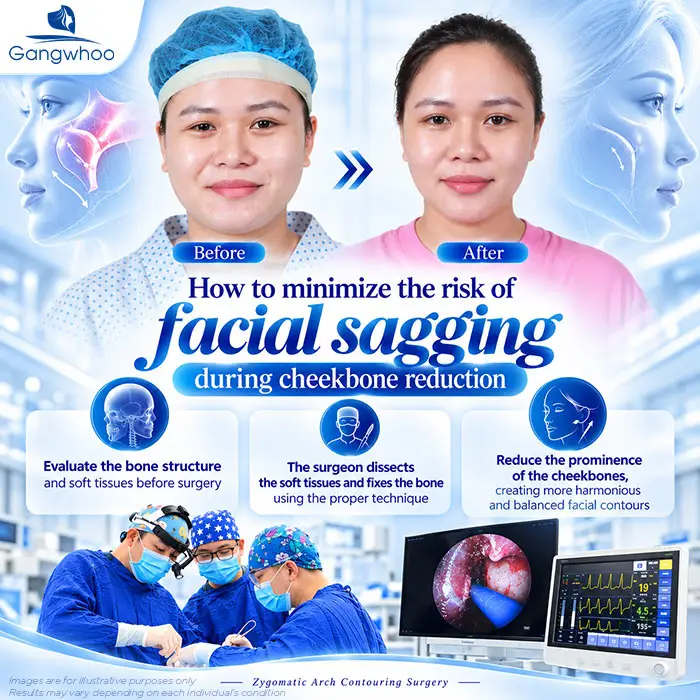
1. Evaluate bone structure and soft tissue before surgery
A sound cheekbone reduction plan begins with evaluating the face from multiple angles.
At specialized facilities, the surgeon may combine clinical examination with imaging such as a maxillofacial CT scan/3D CT, depending on the case, to assess bone structure and plan the surgery. Vinmec also describes preoperative examination as including facial assessment, maxillofacial CT, X-ray when needed, and analysis of this data before the surgical plan is developed.
It is important to remember that CT images do not replace a direct examination. The surgeon must combine imaging data with the condition of the soft tissue, facial proportions, and the patient’s realistic expectations.
2. Control the extent of soft tissue dissection
In maxillofacial surgery, “minimally invasive” should not be understood simply as having a small incision.
More important is precisely controlling the scope of the intervention, preserving as much as possible the anatomical structures that do not need to be disturbed, and working in a controlled manner within the surgical field.
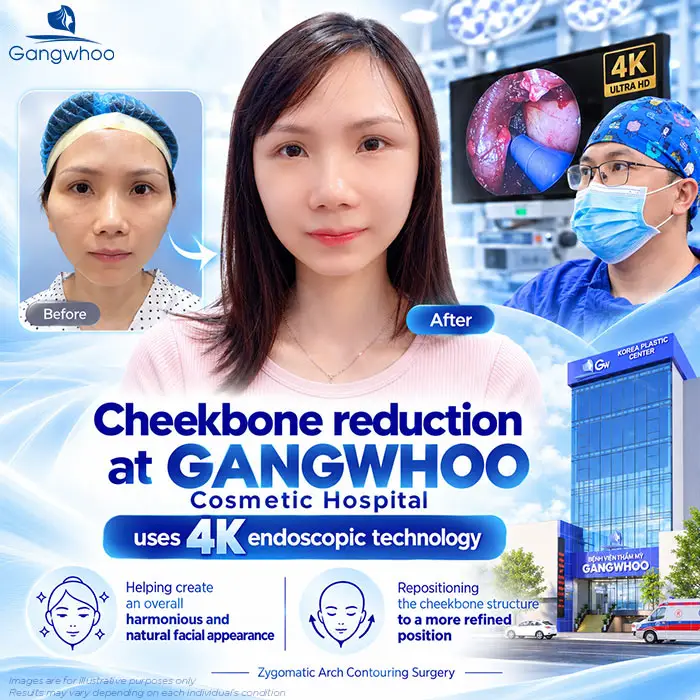
At Gangwhoo Cosmetic Hospital, the hospital’s professional materials state that a 4K endoscopic system is used to support visualization of the surgical field, helping the surgeon see structures such as blood vessels, nerves, and the bone area to be treated more clearly. The procedure is also presented as combining microsurgical techniques to increase precision.
3. Fix the bone using proper technique
After the bone is cut and moved to the planned position, the bone segments must be fixed appropriately with maxillofacial fixation devices.
In cheekbone reduction, maxillofacial plates and screws are an important part of stabilizing the bone structure after adjustment. Vinmec also describes fixing the bone segments with maxillofacial plates and screws in the surgical procedure.
However, it should not be assumed that having plates and screws completely eliminates the risk of complications. The fixation method, as well as the number and position of the fixation devices, must be decided by the surgeon based on anatomy and the actual surgical technique.
4. Follow postoperative care instructions
After cheekbone reduction, patients must follow the doctor’s instructions on hygiene, diet, activity, and follow-up visits.
Some protocols may require the use of a compression bandage or facial support garment for a certain period to help control swelling and support soft tissue adaptation. The exact duration should not be applied as a single figure for everyone but should follow the surgeon’s instructions.
Cheekbone Reduction at Gangwhoo Cosmetic Hospital: Technology to Help Reduce the Risk of Facial Sagging
When performing cheekbone reduction, one of the things I care about most is not only adjusting the cheekbone itself but also preserving soft tissue and adjacent anatomical structures. This matters for how well the cheek adapts after surgery and helps limit undesirable changes in facial contours.
At Gangwhoo Cosmetic Hospital, cheekbone reduction is supported by specialized equipment such as the Harmonic ultrasonic scalpel, the 4K endoscopic system, and the Aesculap bone-cutting device. Combining these technologies gives the surgeon better visualization of the surgical field, better control over bone work, and less unnecessary impact on surrounding soft tissue.
1. Harmonic ultrasonic scalpel – supporting controlled soft tissue handling
Harmonic is a technology that uses ultrasonic energy to help cut and coagulate tissue during surgery. In maxillofacial procedures involving soft tissue, controlling tissue damage and bleeding in the surgical field are factors surgeons pay close attention to.
In cheekbone reduction, the goal is not simply to reach and adjust the bone but also to limit unnecessary trauma to the surrounding soft tissue. This is one of the important principles when aiming for a stable, natural-looking face after surgery.
2. 4K endoscopic system – clearer view of anatomical structures
One notable point in maxillofacial surgery at Gangwhoo is the use of the 4K endoscopic system.
This system magnifies and clearly displays the surgical field, allowing the surgeon to see the bone to be treated as well as adjacent soft tissue structures more clearly. In cheekbone surgery, direct visualization is valuable for controlling the extent of dissection and working precisely according to the planned approach.
From a professional standpoint, I consider this an important supporting factor, since limiting unnecessary soft tissue damage is one of the principles that must be prioritized in cheekbone reduction.
3. Aesculap equipment – supporting precise bone cutting
In addition to endoscopy, Aesculap is an equipment system used in maxillofacial bone surgery to support bone cutting and reshaping.
In cheekbone reduction, the surgeon must accurately determine the cutting position, the direction of movement, and the degree of adjustment based on each person’s anatomy. Using specialized equipment allows bone work to be better controlled, rather than applying the same method to every case.
More importantly, the equipment is only effective when used by a surgeon with knowledge of maxillofacial anatomy and appropriate surgical experience.
4. Technology combined with a specialist surgeon to aim for results without sagging
I always emphasize that no single piece of equipment can determine the outcome of a cheekbone reduction.
To limit unwanted soft tissue changes after surgery, several elements must work together: bone structure assessment through imaging, soft tissue analysis, determining the appropriate degree of reduction, controlled dissection, precise bone cutting, proper bone fixation, and postoperative monitoring.
With the support of the Harmonic ultrasonic scalpel, 4K endoscopy, and Aesculap equipment, together with a personalized surgical process at Gangwhoo Cosmetic Hospital, the aim is to minimize unnecessary impact on soft tissue and create favorable conditions for the cheeks to adapt to the new bone structure, thereby reducing concerns about sagging after cheekbone reduction.
So if you are researching whether cheekbone reduction causes facial sagging, rather than focusing only on “how much can be reduced,” pay attention to the surgeon performing the procedure, the supporting technology, the soft tissue preservation methods, and the postoperative care process. These are the factors to consider when choosing a facility for cheekbone reduction surgery.