
What should you do if your chin implant becomes off-center? This is a concern for many people after chin augmentation surgery, especially when they notice the chin area is no longer aligned with the face’s midline, the chin tip appears to lean to one side, or the chin’s overall shape looks abnormal.
However, not every case of a crooked-looking chin after surgery means the implant itself has actually shifted position. In the early post-operative period, uneven swelling and bruising between the two sides of the soft tissue can temporarily make the face look asymmetrical.
From a Dentistry and Maxillofacial specialist’s perspective, the most important thing when facing this situation is not to attempt to adjust the chin yourself, but to identify the underlying cause of the asymmetry before deciding whether intervention is needed.
What to do if your chin implant is off-center?

If you notice your chin looks crooked after augmentation, the first thing to do is stay calm and assess when the issue appeared and what symptoms accompany it.
In the days or weeks right after surgery, the soft tissue in the chin area is usually not yet fully stable. Swelling on the two sides may be uneven, making the jawline and chin tip look temporarily off-center. If this is gradually improving as recovery progresses and no other unusual signs appear, the doctor may simply recommend continued monitoring and post-operative care.
On the other hand, if the asymmetry is clearly visible, isn’t improving, or is getting worse, a follow-up visit is needed so the doctor can check the position of the implant material, the surrounding soft tissue, and the condition of the surgical site.
In particular, patients should not try to push the implant back into place, massage the area forcefully, or press or manipulate the chin themselves. Improper mechanical pressure at the wrong time can damage healing tissue and make the situation more complicated.
At Gangwhoo Aesthetic Hospital, evaluating chin-related issues should be based on a direct clinical examination and each individual’s specific condition, rather than relying solely on photos or subjective impressions.
Why does a chin implant become off-center?

There are many possible reasons why the chin shape may look uneven after augmentation. Identifying the exact cause matters because each cause calls for a different approach.
1. Post-surgical swelling that makes the chin appear crooked
This situation needs to be distinguished from an actual implant shift.
After surgery, the natural inflammatory and healing response can cause soft-tissue swelling. The degree of swelling on each side isn’t necessarily equal. When one side swells more than the other, the chin’s contour can look as if it’s being pulled toward the opposite side.
During this stage, judging the cosmetic outcome too early can lead to an inaccurate assessment. Doctors typically need to monitor how things progress over time in order to distinguish ordinary post-operative swelling from a genuine issue with the implant’s position.
2. The chin implant shifting from its original position
Another cause is the implant material no longer sitting in its intended position.
Anatomically, the chin area is closely connected to the lower jawbone, periosteum, chin muscles, and the soft tissue covering them. When the implant shifts position, the shape of the chin tip and the contour of the mentum region can change accordingly.
Patients may notice the chin leaning left or right, the chin tip no longer sitting on the face’s midline, or a feeling that the chin area is less stable than before.
However, a visibly crooked chin alone isn’t enough to conclude that the implant has shifted. A doctor needs to examine the patient directly to determine whether the issue lies in the soft tissue, the implant’s position, or the underlying bone structure.
3. An implant that doesn’t suit the chin’s anatomy
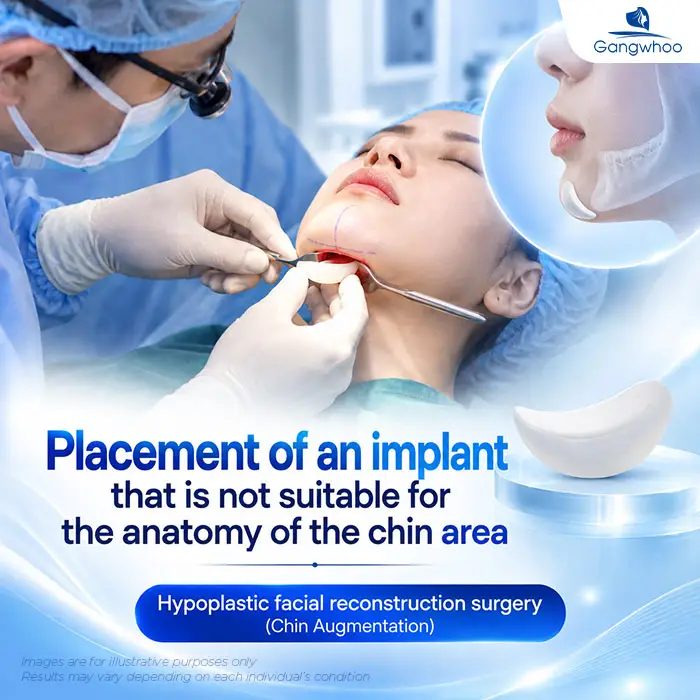
Every face has different anatomical characteristics. Chin symmetry doesn’t depend on implant size alone — it’s also tied to the shape of the lower jawbone, the balance between the two sides of the face, the bite, the degree of chin projection, and the proportions of the lower third of the face.
If the implant’s design and placement don’t match the patient’s anatomy, the post-surgical result may fall short of the desired symmetry.
This is also why, in chin augmentation surgery, a doctor shouldn’t focus only on the chin tip itself but must evaluate the overall face and jaw structure.
4. Impact or trauma to the chin area

During the post-operative period, the soft tissue and structures in the treated area need time to stabilize. Strong impacts, collisions, or prolonged pressure on the chin can affect the recovery process.
For this reason, anyone who has recently had chin augmentation should follow post-operative care instructions and keep to their scheduled follow-up visits.
5. Abnormal issues during the healing process
Beyond cosmetic concerns, an abnormal change in the chin can also be linked to post-operative complications that require a doctor’s evaluation.
If the crooked chin comes with increasing pain, unusual redness and swelling, warmth in the surgical area, abnormal discharge, fever, or changes at the incision site, the patient should contact a medical facility for an examination rather than continuing to monitor it on their own for an extended period.
How can you tell if a crooked chin is from swelling or from the implant?
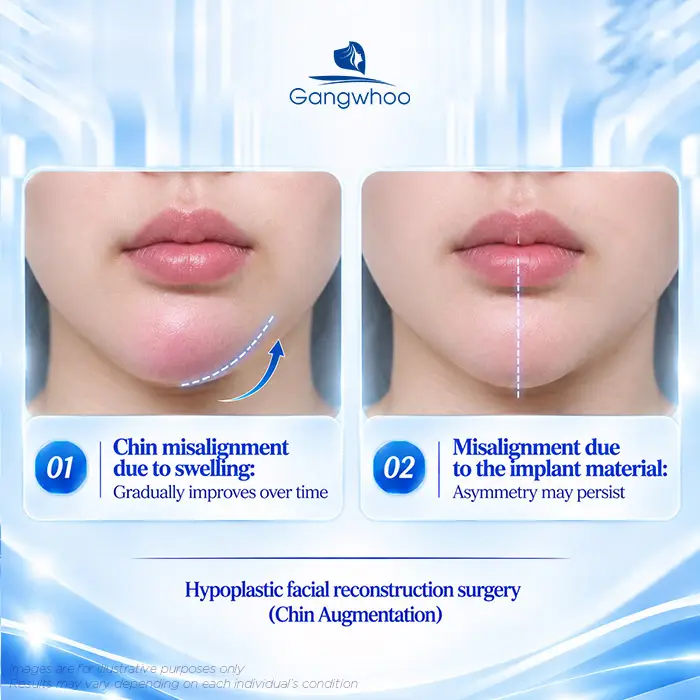
This is one of the most important questions when dealing with an off-center chin implant.
A crooked chin caused by swelling usually shows up during the early recovery stage. The face’s shape can change along with the degree of swelling and tends to improve as the swelling goes down.
By contrast, if the issue genuinely involves the implant’s position, the asymmetry tends to be more clearly persistent and doesn’t improve as swelling subsides.
That said, these are only general indicators. Patients shouldn’t self-diagnose by assuming “a crooked chin must mean the implant has shifted” — or the opposite.
In clinical practice, a doctor needs to assess the soft tissue, the position of the chin tip, the face’s midline, the balance between the two sides of the jaw, and the position of the implant material. Depending on the case, the doctor may also order imaging studies if needed for a more accurate assessment.
How is an off-center chin implant corrected?

1. Monitoring, if the cause is post-operative swelling
If the doctor determines that the asymmetry is mainly due to swelling and there’s no sign the implant has shifted, the appropriate approach may simply be continued monitoring along with proper post-operative care as instructed.
During this period, patients shouldn’t rush into another intervention just because the final shape hasn’t been reached yet.
2. Adjustment when the implant’s position is the issue
If the examination shows the implant isn’t correctly positioned, or the chin’s shape has been significantly affected, the doctor will assess the extent and cause before deciding on a course of action.
Not every case requires removing the implant. Whether adjustment, repositioning, or replacing the material is needed must be decided based on the patient’s actual condition.
3. Revision surgery
In cases with a clearly crooked chin, or where the outcome falls short due to an implant-related issue, revision surgery may be considered.
Technically speaking, revision surgery is not simply a repeat of the original chin augmentation procedure. The doctor needs to assess the condition of the soft tissue, scar tissue, the implant’s position, the underlying bone, and the cause behind the previous outcome.
The goal of revision surgery isn’t just to bring the chin back to a symmetrical position — it also needs to minimize tissue damage and build a plan suited to each patient’s individual anatomy.
How long after a chin implant becomes off-center can it be corrected?
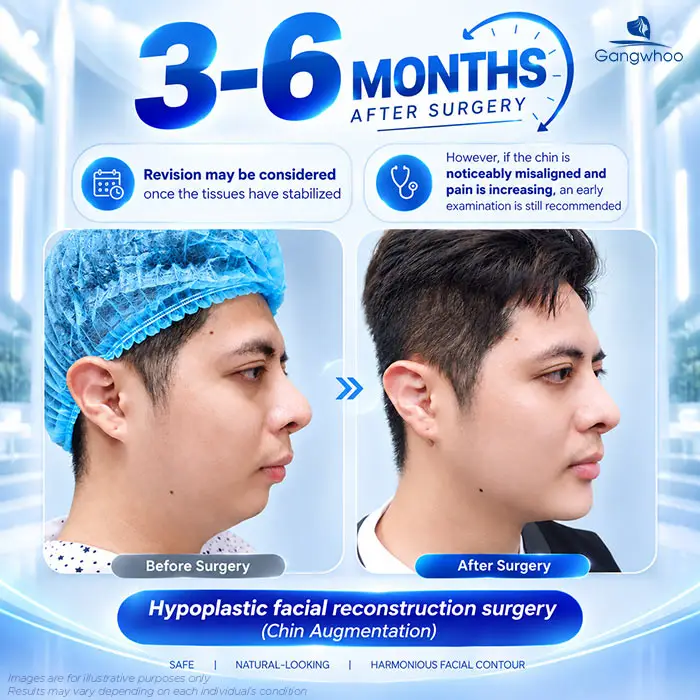
Generally, if the chin is only slightly asymmetrical due to post-surgical swelling, the doctor may monitor it for about 4–8 weeks to let the soft tissue stabilize before making a clearer assessment of the outcome. The chin’s shape can continue to change over a period of 3–6 months, depending on the individual’s body, the technique used, and the extent of the procedure.
If the implant is suspected to have shifted but there are no signs of infection or acute complications, revision surgery is typically considered after around 3–6 months. This period allows the soft tissue’s swelling to go down and the tissue around the surgical site to stabilize further, giving the doctor a more accurate basis for identifying the cause before operating again.
However, patients shouldn’t wait for the 3–6 month mark if unusual signs appear, such as increasing pain, redness and swelling, warmth in the chin area, abnormal discharge, an open incision, or fever. In these cases, patients should contact their doctor or a medical facility for prompt examination, since treatment may be needed before the usual timeline for cosmetic revision.
For cases where the chin is clearly off-center due to a shifted implant that is causing pain, putting pressure on the soft tissue, or carrying a risk of infection, the doctor may recommend earlier intervention. The exact timing shouldn’t be decided by the patient alone — it should be based on a direct examination, the condition of the soft tissue, the implant’s position, and the cause of the asymmetry.
A Trusted Place to Correct an Off-Center Chin Implant – Techniques That Help Reduce the Risk of Shifting
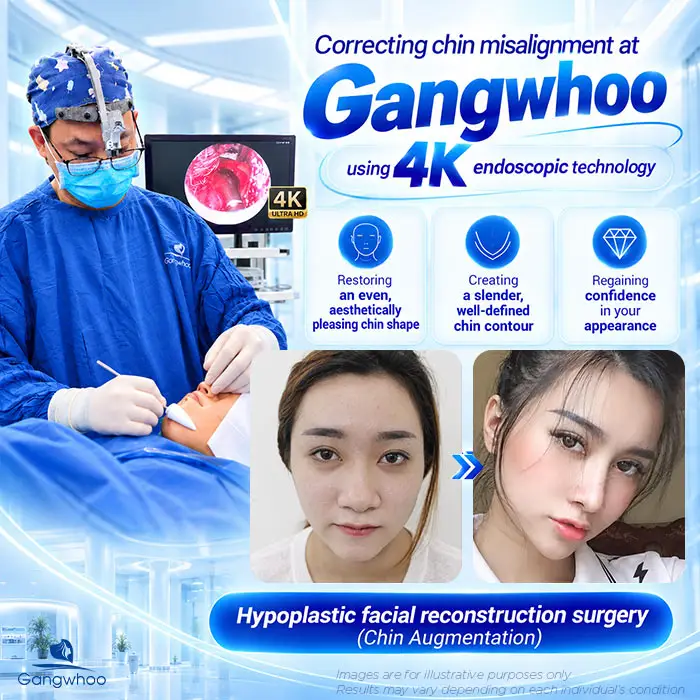
When a chin implant becomes off-center, choosing a doctor with the right expertise and surgical technique plays an important role. At Gangwhoo Aesthetic Hospital, chin shaping and correction procedures are performed with the support of microsurgical technique and a 4K endoscopic system, which improve visualization of the surgical area’s structures and help the surgeon operate with greater precision.
In suitable cases, the chin implant can be fixed to the underlying bone with specialized screws, which increases stability and reduces the risk of the material shifting. That said, the fixation technique chosen depends on the jawbone structure, the type of implant, and each patient’s actual condition.
In addition, the 4K endoscopic system helps magnify and clearly visualize the surgical field, while the microsurgical technique focuses on precise movements that limit unnecessary tissue damage. Together, these aim to shape a chin that is symmetrical, stable, and well-suited to each individual’s facial features.
For someone who has previously experienced an off-center chin implant, the doctor needs to evaluate the cause, the implant’s position, the underlying bone, and the soft tissue before deciding on a correction. Dr. Nguyen Minh Hien (Level II Specialist), from the Dentistry and Maxillofacial department at Gangwhoo Aesthetic Hospital, is one of the doctors specializing in this field.
Photos of Chin Augmentation Patients at Gangwhoo Aesthetic Hospital
If you’re currently dealing with an off-center chin implant, you can visit Gangwhoo Aesthetic Hospital to have a Dentistry and Maxillofacial specialist examine you directly, identify the cause, and advise on the correction approach best suited to your specific condition.